

Key Takeaways:
- Shadow IT now includes SaaS sprawl, OAuth consent chains, shadow AI, and forgotten APIs that quietly expand your attack surface.
- With perimeter boundaries dissolving, continuous asset discovery is the new base of security visibility. Use CASB, EASM, SSO telemetry, and API discovery together to find what you don’t know you have.
- Handle OAuth grants and AI uploads like key security signals. They are prime paths for leaks and ongoing access.
- Fast intake, time-framed exceptions, inline suggestion, and DLP balance speed with control.
- Feed found assets into automated DAST and manual pentests, rescan to prove fixes, and report metrics that leadership understands.
Today, with a rise of 48% in remote-first teams in the global workforce and generative AI, employees are increasingly bypassing IT for speed, exposing entire enterprises to the risk. Shadow IT now covers unauthorized SaaS, OAuth grant chains, shadow APIs, and even unapproved AI agents that process your most sensitive data without your knowledge.
This guide answers what is Shadow IT? with a modern perspective, explores urgent risks that go beyond traditional device management, reveals detection blind spots most security teams miss, and offers a brief, continuous playbook to manage it.
What is Shadow IT? (and its Causes)
Shadow IT refers to any software, hardware, cloud service, or API that employees use without IT’s visibility, vetting, or approval. It’s rarely malicious but rather a rational response to operational needs that IT-approved tools fail to meet. Also, OAuth apps or APIs become shadow only when deployed or granted access without IT governance.
A typical org usually assumes they are running 30-40 apps. Reality? They are operating thousands. Studies consistently show that approx 40-70% of SaaS usage in enterprises is unsanctioned, with widespread user-driven adoption across Fortune 1000 companies.
Modern Shadow IT categories now include:
- OAuth-enabled apps: Productivity tools that grant persistent access to corporate data through “Sign in with Google” or Microsoft flows, creating cloud-to-cloud blind spots
- Unmanaged browser add-ons: Extensions collecting sensitive page data or session credentials from enterprise applications
- Personal device apps: Consumer tools like Dropbox or personal Gmail handling work data outside corporate controls
- Shadow AI: Employees uploading proprietary code, memos, or client data to ChatGPT and similar tools for improved productivity
- Shadow/Zombie APIs: Undocumented or legacy endpoints remaining exposed, often bypassing central authentication
Causes of Shadow IT
The causes of Shadow IT mostly emerge from fundamental friction between business velocity and IT processes:
1. SaaS consumerization & remote work:
Employees in remote settings adopt SaaS tools with better UX, effectiveness, and easier access for speed while getting rid of tiring IT approval frustration.
2. Low-friction OAuth & app marketplaces:
Persistent, scope-based access creates blind spots in cloud security. Users can grant third-party apps access to corporate data with a few clicks via “Sign in with Google” or Microsoft flows. These OAuth consent screens create persistent token access that bypasses traditional network monitoring.
3. Explosion of Gen-AI apps/agents:
Workforce AI use and proprietary data uploads are surging, which is often outside IT policy.
4. API sprawl/microservices:
Agile development and containerization enable developers to deploy APIs quickly for bug fixes, PoCs, or partner integrations without formal documentation. This creates undocumented “shadow” or “zombie” endpoints that remain exposed. These endpoints often bypass traditional reviews and remain live long after projects end.
Expert Take: A verified user in r/ITManagers suggests that shadow IT is a symptom of a lack of accountability and responsibility to properly manage systems. The problem is that the perception from business users is “IT is too slow, the process is too cumbersome, and too costly.”
Is user friction fueling your Shadow IT sprawl? We help build security that enables speed.

Examples of Shadow IT
Here are some prominent examples of shadow IT in 2025:
| Example | Category | Risk & Governance Gap |
|---|---|---|
| Personal cloud storage for work files | Unsanctioned SaaS | Sensitive docs synced outside DLP/retention or compliance exposure |
| Unapproved video/chat platform | Unsanctioned SaaS | Data residency or compliance gaps |
| OAuth-granted ‘productivity’ app | OAuth Grant | Consent phishing or over-scoped access to M365/GWS data |
| Browser extension collecting page data | Unauthorized applications | Credential/session leakage on enterprise apps |
| Shadow AI app/agent | Shadow AI | Uploading prompts/files to third-party AI. This leads to IP or PII being leaked into third-party models |
| Shadow/zombie API endpoint | Shadow API | Undocumented, internet-exposed routes often lack authentication and are actively probed |
| Contractor-operated SaaS in a separate tenant | Rogue IT | No SSO/DLP and data exits governance |
What Risks Does Shadow IT Bring?
Though many risks come up with shadow IT, here are the five biggest threats you should definitely take care of:
1. Expanded Attack Surface & Blind Spots:
Unknown SaaS, unmanaged devices, and undocumented APIs evade standard security controls. Industry studies indicate a significant proportion of breaches involve unsanctioned tools, with average remediation costs exceeding $4 million USD.
Attackers systematically probe certificate transparency logs for forgotten subdomains. They scan shadow cloud services for default credentials and abuse OAuth consent flows to bypass perimeter defenses. Without a complete inventory, incident response becomes guesswork, and compliance audits fail because tools slipped outside governance.
2. Data Loss & Compliance Exposure:
Sensitive data leaving governed systems creates massive audit gaps. When PII, PHI, or PCI data moves into personal apps or AI tools, it bypasses corporate DLP and retention policies.
Regulators expect you to be aware of where your data resides. Shadow IT breaks that chain. The SEC’s $1.1 billion fine against Wall Street firms for using unauthorized communication tools, such as WhatsApp, demonstrates real consequences for this practice.
3. OAuth Consent Phishing & Over-Scoped Access:
Modern attackers skip password theft. They exploit OAuth’s delegated access model to obtain persistent tokens via malicious app consent, often bypassing conditional access and MFA.
This creates persistent token access through social engineering tactics that trick users into granting permissions to malicious applications. A seemingly innocent productivity app requesting “full access to your mail” or “view and manage all files” becomes a backdoor.
4. Shadow AI Misuse & Leakage:
Gen AI adoption is exploding, often outside IT oversight. Employees upload proprietary code, internal memos, or client data to boost productivity, unaware of the risks.
The Samsung incident, in which engineers leaked proprietary code into ChatGPT, illustrates how quickly this can happen. Without policies or DLP around AI use, a single prompt can broadcast sensitive content.
Blanket blocking drives usage underground. A better approach is real-time coaching with DLP enforcement. Try pairing inline nudges with approved internal AI tools.
Worried about AI tools leaking IP or important data? Our experts can help you build a protective AI-secure infra.
5. Shadow/Zombie APIs:

More than 90% of organizations report API-related attacks targeting undocumented or shadow endpoints. These undocumented, internet-exposed endpoints lack proper authentication and monitoring.
They are actively probed by attackers who use automated tools to discover forgotten routes. A legacy API left running after a project ends becomes a perfect entry point for data theft.
How to Detect Shadow IT: Tools & Methods

No single tool covers everything. Hence, a layered, discovery-first approach is required:
CASB / SSE App Discovery
Cloud Access Security Broker (CASB) and Security Service Edge (SSE) platforms analyze traffic logs against continuously updated app catalogs. They automatically identify and risk-score unsanctioned applications.
This creates your initial inventory, categorizing high-volume apps worth approving from the long tail of one-off tools. CASB discovery gives you a live feed of your actual SaaS footprint, not just the approved list.
Network & Endpoint Telemetry
Use proxies, firewall/SWG logs, and endpoint agents to detect app usage patterns and browser extension activity. This complements CASB for coverage when logs are fragmented.
Forward proxy logs showing large uploads to consumer cloud services suggest shadow backups. EDR agents can catch unusual app installs or suspicious network calls from browser extensions scraping enterprise data.
SSO & OAuth Governance
Monitor new consent access, flag risky scopes/publishers, and enforce admin approval/revocation policies. This detects cloud-to-cloud access otherwise invisible to network tools.
Regularly review your SSO console for newly consented apps. Flag high-risk attributes like broad scopes, unknown publishers, or apps bypassing admin consent policies.
Are risky OAuth permissions your blind spot? We will help you govern cloud-to-cloud access.
EASM / ASM (External Attack Surface Management)
List out internet-facing domains, apps, and APIs tied to your organization to detect shadow/zombie assets outside internal CMDBs. This bridges IT or security visibility gaps.
EASM tools act like attackers, crawling certificate transparency logs and integrating with cloud provider asset inventories (like AWS, Azure, GCP) to find forgotten subdomains, open admin consoles, or misconfigured cloud storage buckets.
SSPM / CAASM
Continuously assess SaaS posture and correlate assets across systems to reduce drift and misconfigs that enable Shadow IT.
These tools provide unified inventory across clouds, identities, and SaaS applications. They highlight when approved apps drift out of compliance or when new unauthorized services appear.
API Discovery & Monitoring
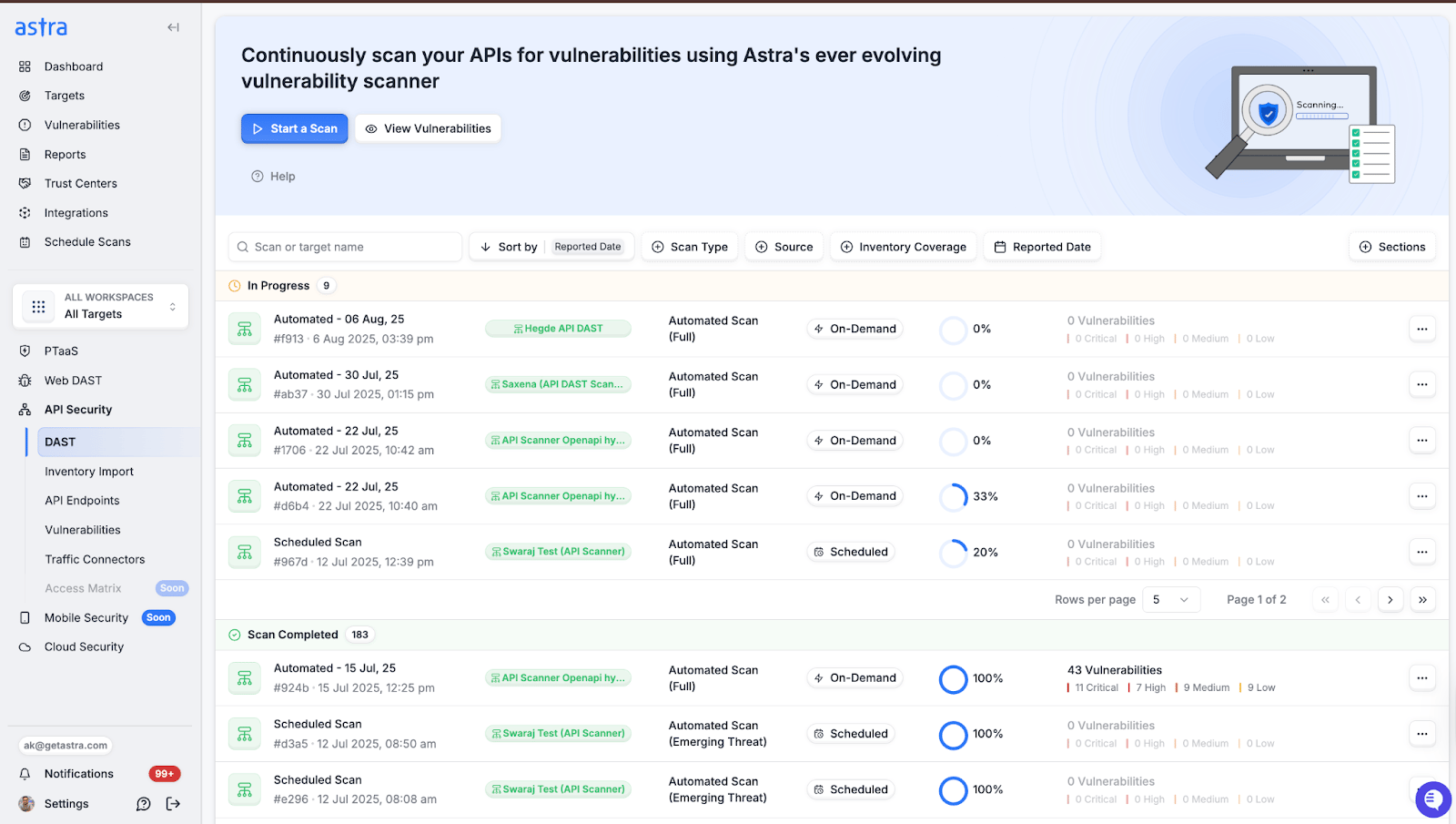
Specialized API discovery tools map endpoints, compare them with design/docs, and flag orphaned, zombie, or shadow APIs that need testing. They detect risk beyond gateway visibility.
Active monitoring ensures newly discovered shadow endpoints get tested and patched before attackers find them.
How to Manage and Reduce Shadow IT (Continuously)

1. Service Catalog with Fast Intake
Provide pre-approved options and a lightweight request path to reduce unsanctioned tool adoption for employees. Make the approved list rich and the approval process fast.
Best Practice: Include security experts in product-related teams to route requests and enforce guardrails at the edge.
The goal here is to meet employees where they are with secure options that match their needs, plus a clear path when they need something new. This addresses the root cause, i.e, slow, cumbersome IT processes.
2. Risk-Based Exception Management
Time-framed approvals with owners, data classification, and compensating controls (like DLP, limited scopes) for tools that provide genuine business value.
Best Practice: Minimize over-scoped OAuth access by default, enforce least privilege, verified publishers, admin consent policies, and alert on anomalous grants.
Don’t reflexively ban useful tools. Use tiered risk management. Low-risk tools get fast approval, and high-risk tools need additional controls and shorter review cycles.
3. User Coaching Over Blanket Blocking (especially for Gen AI)
Real-time prompts and guided alternatives drive safer behaviour without killing dev velocity. Intercept uploads to public AI tools with warnings and suggestions for approved alternatives.
Best Practice: Pair inline nudges with DLP enforcement for uploads to Gen-AI tools and track effectiveness. Run tabletop exercises on AI data-leak or consent-phishing scenarios to pressure test response.
Hard blocking pushes employees to use the application underground. Strategic coaching with enforcement creates compliance while maintaining productivity.
Is blocking Gen AI creating more Shadow IT? Learn from experts how to coach your teams, not block their productivity.
4. Monthly OAuth & Browser-Extension Reviews
Revoke stale access, restrict risky scopes or publishers, and remove high-risk extensions. Document outcomes to show continuous improvement.
Make this routine hygiene, not a crisis response. Regular cleanup prevents drift and reduces attack surface over time.
5. EASM→Scan→Fix Loop
Route newly discovered externals/APIs into DAST API testing. Verify fixes with rescans and track MTTR.
Best Practice: Continuously enumerate externals with EASM, integrate CASB/EASM feeds into validation (DAST/API), and prioritize by exploitability + data sensitivity.
This changes reactive security into proactive defense. New shadow assets don’t just get logged, they get validated and secured automatically.
Found a Shadow API? Learn how you can automate its journey from discovery to a verified fix.
6. Ownership & Asset Lifecycle Hygiene
Assign asset owners, define data handling rules, and ensure deprovisioning at project end or contractor offboarding.
Best Practice: Integrate ownership models and lifecycle rules into policy refresh cycles, and avoid zombie APIs or orphan SaaS tenants.
Clear ownership prevents “zombie” assets. When projects end or contractors leave, assets get properly decommissioned instead of becoming shadow security risks.
What Metrics Should You Track?
| Metric | Purpose | Strategic Value |
|---|---|---|
| Number of unsanctioned apps (net new/month) | Track Shadow IT growth or reduction | Measures governance effectiveness |
| Time-to-approval | Measure service catalog efficiency | Proves IT isn’t a velocity bottleneck |
| OAuth risk reduction (no. of risky grants removed) | Quantify cloud-to-cloud risk reduction | Shows proactive threat mitigation |
| Percentage of ext. assets discovered, validated, and secured | Track EASM to scan to fix maturity | Showcases proactive risk management |
| DLP violations in Gen AI tools | Measure AI security recommendation effectiveness | Shifts from “ban” to “managed risk” |
| Mean time from discovery to remediation | Track vulnerability lifecycle | Shows operational security health |
How Can Astra Security Help?
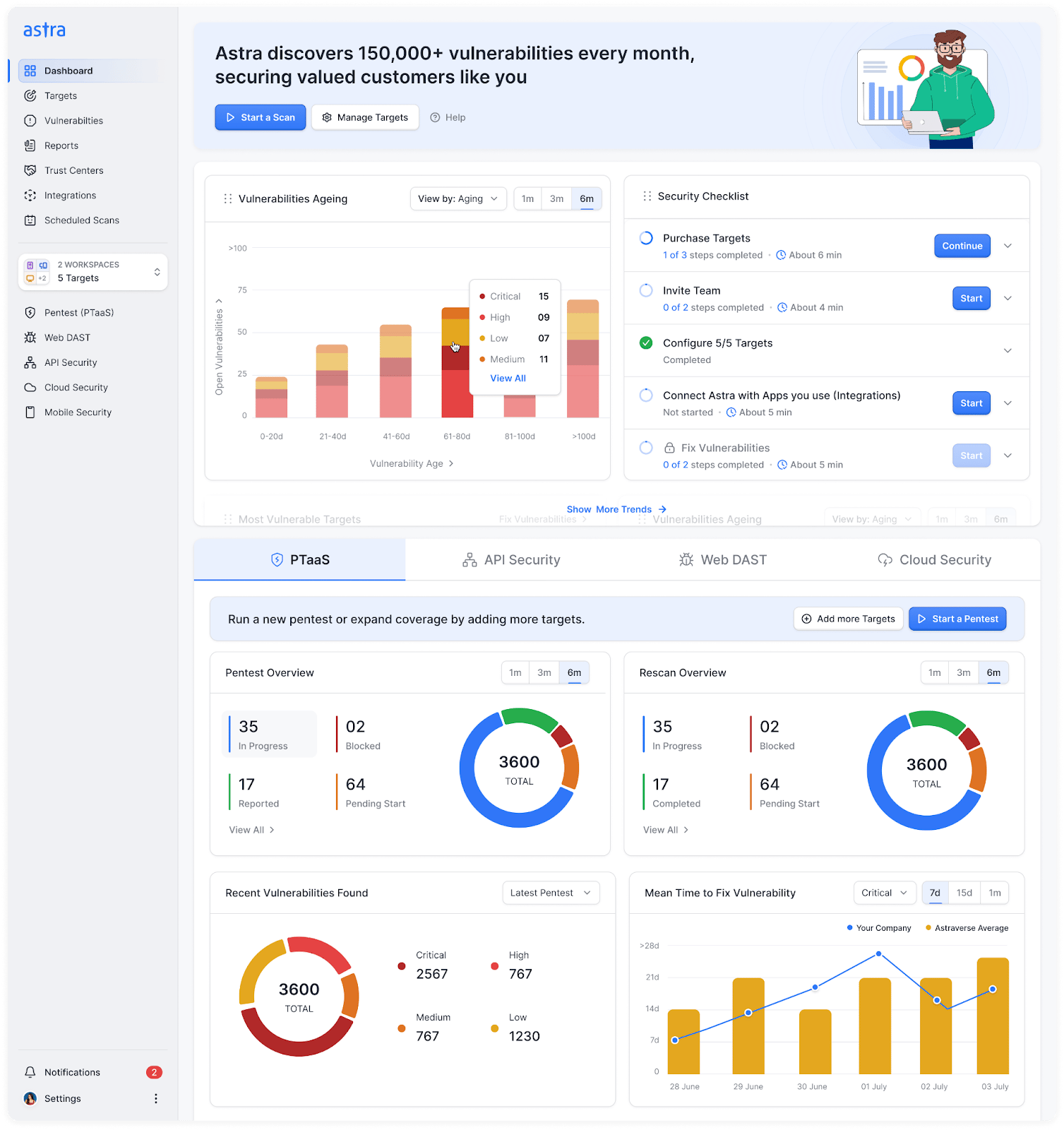
Key Features:
- Uncover vulnerabilities across your attack surface, be it web apps, APIs, cloud, or mobile apps.
- Discover forgotten shadow API endpoints and zombie routes in >30 mins.
- Modern offensive DAST for shadow APIs with live traffic capture.
- 15,000+ test cases, including OWASP API Top 10, and others.
- CI/CD integrations that auto-route CASB/EASM-discovered assets into continuous validation.
Astra’s API Security Platform acts as your EASM layer, continuously discovering shadow assets across your infra alongside feeds from your CI systems. It discovers forgotten endpoints and zombie APIs, runs 15,000+ tests, and uses live traffic connectors to catch real runtime risks like BOLA, IDOR, and authentication bypass flaws that spec checks miss. Findings are human-verified, so your team sees signal, not noise.
Results flow into your resolution center and existing pipelines with video PoCs, rescans to validate fixes, and exportable, audit-ready reports in the Trust Center. Deep integrations with Postman, Slack, Jira, and CI/CD tools speed remediation and measurably reduce MTTR and cloud-to-cloud risk.
Final Thoughts
Stop thinking of shadow IT as a nuisance. Treat it as a measurable part of your attack surface and a set of problems you can solve. Identify the apps and APIs that people in your organization use, and then prioritize them based on data sensitivity and exploitability.
Validate fixes with continuous testing and rescans to ensure problems do not recur. Pair fast intake paths and inline suggestions for users with governance that moves at product speed. Track clear metrics and report them to leadership. Because teams that align discovery, validation, and ownership reduce surprises and keep development moving forward.
FAQs
Why is Shadow IT considered a risk?
Shadow IT often bypasses approved security controls and policy checks. That creates data exposure, compliance gaps, and backdoor entry points. In fact, many breaches start with unauthorized tools.
What is SaaS sprawl, and how is it related to Shadow IT?
SaaS sprawl means uncontrolled growth of cloud apps across the organization. It’s a key subset of Shadow IT because many of those apps are unsanctioned and unmanaged, hiding behind everyday business use.
What are the benefits of shadow IT?
Shadow IT often boosts productivity and gives teams tools that suit their workflow faster than formal IT processes. It lets innovation surface unmet needs that IT can later formalize.
What is the difference between shadow IT and rogue IT?
Shadow IT is usually harmless and grows informally when users bypass IT. Rogue IT is more aggressive or malicious, intentionally using or introducing systems against governance. Shadow IT is often a symptom. Rogue IT is a conscious violation.