

Key Takeaways:
- Legacy DAST tools fail with SPAs: they can’t handle client-side routing, JS-rendered content, or async APIs.
- SPAs hide their attack surface behind JavaScript execution and token-based auth.
- Old scanners overlook real threats, providing false confidence due to incomplete coverage.
- Modern DAST must behave like a real browser, running JavaScript, handling tokens, mapping dynamic APIs, and testing application logic.
- Astra Security accomplishes all this by combining headless scanning, API discovery, manual testing, and CI/CD integration.
The majority of web experiences are currently developed with Single Page Applications to offer a fast, seamless, and undeniably effective user experience. Frameworks such as REACT, Angular, and Vue.js have turned the browser into an application runtime rather than a passive page loader.
Nevertheless, this transition is associated with a security price that most teams continue to underestimate. Dynamic Application Security Testing (DAST) tools were designed to work with simpler web applications. DAST for Single Page Applications (SPAs) is essential for uncovering hidden flaws that lurk behind dynamic UIs, token-based auth, and asynchronous APIs.
Their simple model of crawling server-rendered pages and hyperlinks for vulnerabilities breaks the moment it meets client-side routing, asynchronous API calls, and JavaScript-rendered content. The scanner thinks your app is secure because it never saw most of it.
This disconnect creates not just blind spots but a false sense of confidence. Your app may ship weekly, your features may be complex and stateful, but your DAST report still looks clean. Not because the app is secure, but because the scanner couldn’t reach the actual attack surface.
New to application security testing? Check out the complete guide on DAST
What are Single-Page Applications (SPAs)?
Single-page applications are modern web apps that update content dynamically without requiring page reloads. Instead of fetching entire new pages from the server, they load data in the background and update parts of the interface instantly.
Technically, SPAs load a single HTML shell and utilize JavaScript to control all aspects of the page, including navigation, user actions, and data display. Frameworks like React, Angular, and Vue handle UI changes, route management, and state through API calls (using JSON or GraphQL), rather than traditional server-rendered pages.
From a security tester’s standpoint, SPAs differ dramatically:
- Client-side rendering: No server-generated links. Navigation is handled entirely in JS, so traditional crawlers can’t discover new UI routes.
- API-driven architecture: Nearly all functionality works via JSON/GraphQL endpoints rather than server-rendered pages.
- Asynchronous actions: State and UI changes result from timed or interactive API calls.
- Client-side authentication/state: Logic and access control can rely on JWT or session state stored in the browser’s storage.

Why is Astra Vulnerability Scanner the Best Scanner?
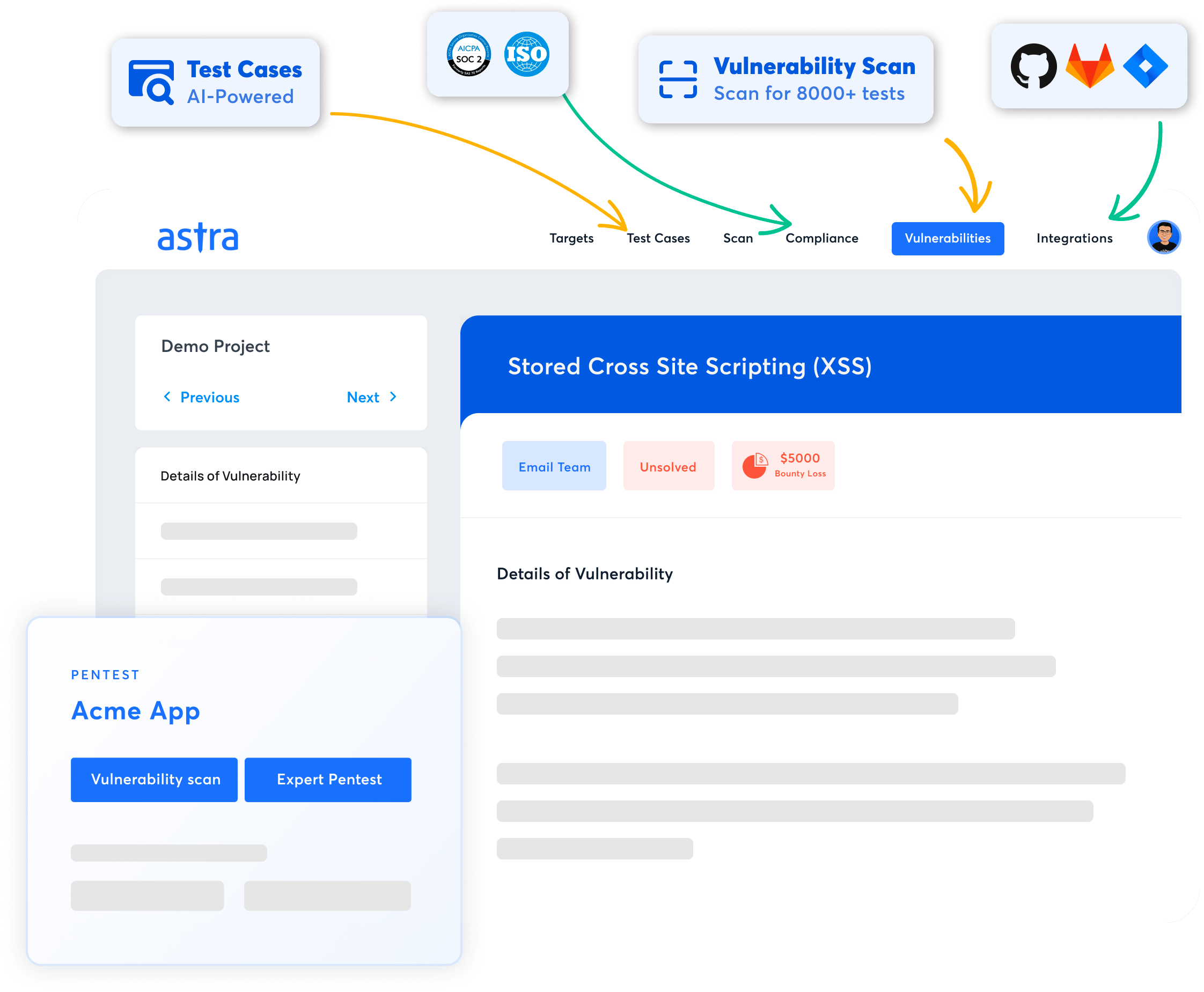
- We’re the only company that combines automated & manual pentest to create a one-of-a-kind pentest platform.
- Vetted scans ensure zero false positives.
- Our intelligent vulnerability scanner emulates hacker behavior & evolves with every pentest.
- Astra’s scanner helps you shift left by integrating with your CI/CD.
- Our platform helps you uncover, manage & fix vulnerabilities in one place.
- Trusted by the brands you trust like Agora, Spicejet, Muthoot, Dream11, etc.

Why Does Traditional DAST Fail with SPAs?
1. Failure to Understand JavaScript-Rendered Content
Standard DAST crawlers are designed to explore applications by following links and submitting forms, essentially navigating the app like a bot that clicks through server-rendered pages.
But SPAs don’t work that way. Instead of using standard <a> tags, they rely on client-side routing handled by JavaScript, think history.pushState(‘/dashboard’). This means there are no real links for scanners to follow, and no page reloads to observe. To a traditional DAST tool, much of the app simply doesn’t exist because it never gets rendered until a user interacts with it.
Without understanding how SPAs load content dynamically, older scanners fail to map the actual structure of the app, missing key views, flows, and inputs entirely.
Their routing is managed client-side, usually through JavaScript frameworks that manipulate the DOM without triggering a full-page reload. The whole app may appear to a legacy DAST scanner as a single page, though it may have dozens of views and states behind virtual routes.
2. Difficulty Handling Asynchronous Operations (AJAX/API Calls)
DAST tools that don’t run JS miss dynamic content entirely. If a form or input field appears only after JS loads, it’s invisible to the scanner. SPAs render most of their content dynamically, meaning the HTML the server returns is skeletal at best.
The actual interface, comprising buttons, forms, fields, and data, is assembled at runtime by JavaScript. Traditional DAST scanners, which often operate without a complete JavaScript engine, see only the static shell. They miss critical inputs, hidden flows, and contextual UI changes that can significantly impact the attack surface.
3. Issues with Modern Authentication and Session Management
Modern SPAs often use token-based authentication, typically with JWTs stored in local storage or managed via client-side state. This breaks the cookie-based session model that many older DAST tools rely on.
Worse, SPA login flows often include multi-step interactions, redirects, and dynamic headers that require real-time execution to authenticate correctly. Without the ability to replicate this flow and manage session tokens, scanners are unable to access a significant portion of the application.
How a Modern DAST Solution Scans SPAs: A Step‑by‑Step Guide
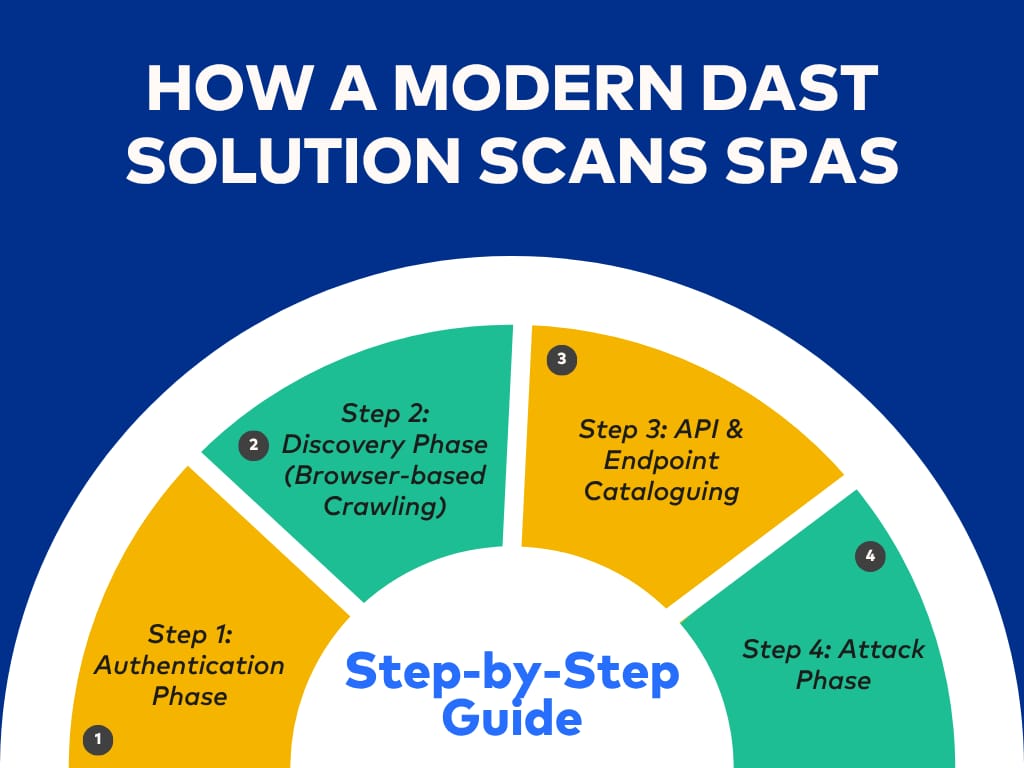
Step 1: Authentication Phase
First requirement: authenticated scans. Tools must support:
- Filling login forms in real browsers (headless or real).
- Extracting tokens (JWT/Bearer) and injecting them into headers in subsequent requests.
- Handling refresh tokens gracefully during scans.
Without this, key areas behind secure endpoints remain untested.
Step 2: Discovery Phase (Browser-based Crawling)
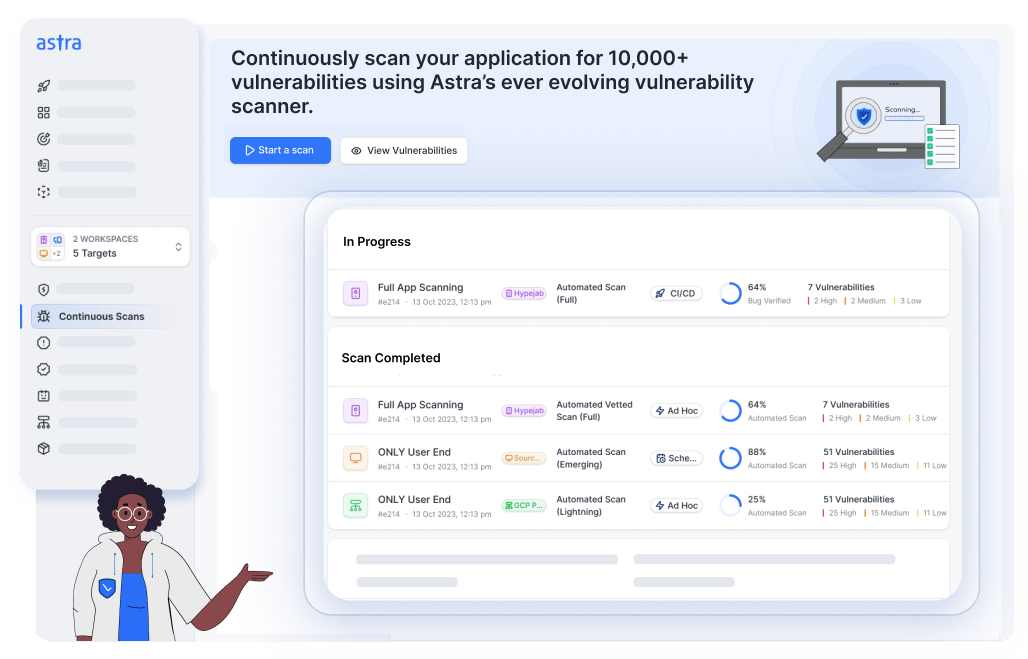
Accurate SPA scanning demands a real browser-based crawler. The process:
- Launch Chromium or Firefox headlessly.
- Visit app entry point (e.g., root URL).
- Simulate fundamental user interactions, including UI clicks, form entries, and navigation.
- Wait for JS-triggered state changes and capture resultant DOM/API calls.
This method reveals paths and inputs that cannot be found through link crawling.
Step 3: API & Endpoint Cataloguing
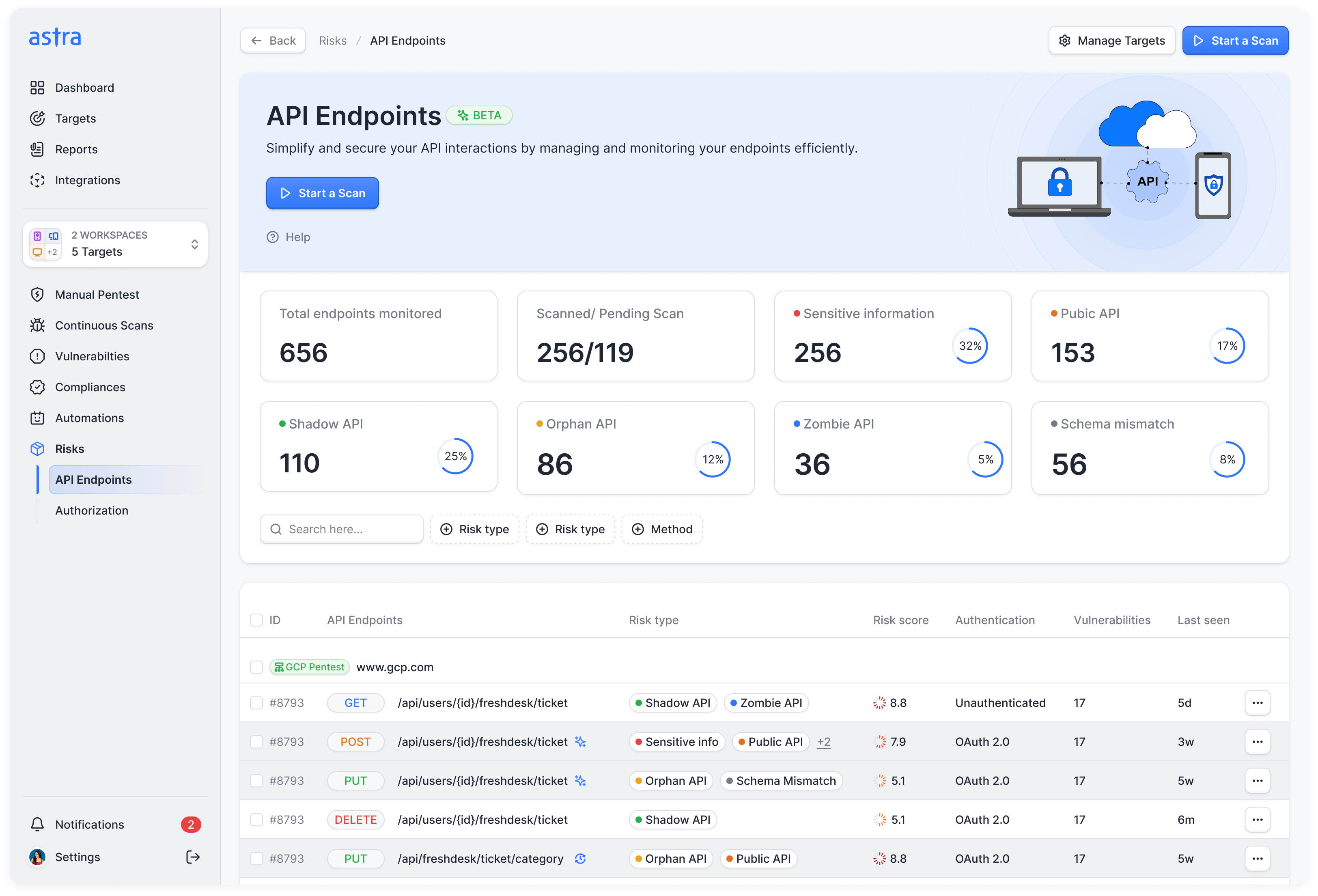
While interacting, the scanner monitors every XHR/fetch call used by the UI, building a catalog of API endpoints, parameters, schemas, and authentication flows. Newer scanners are capable of reading OpenAPI specifications or GraphQL schemas to augment runtime discovery with more comprehensive design-time definitions, which are more complete and insightful.
Step 4: Attack Phase
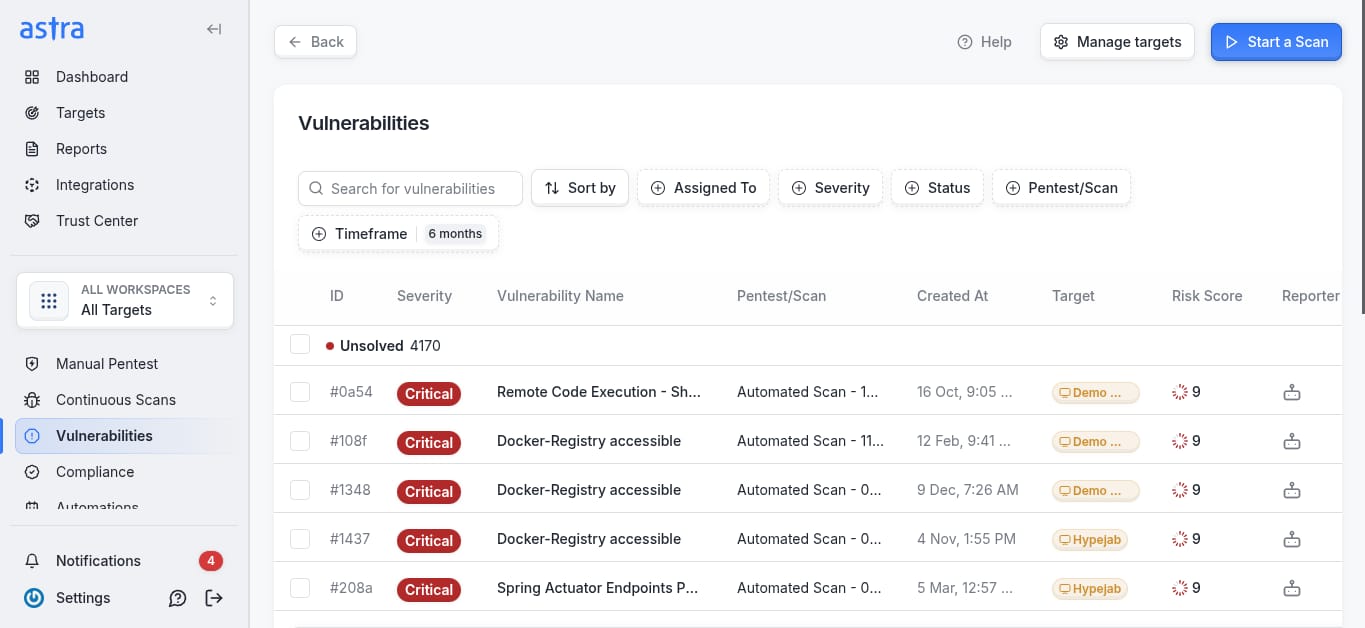
Once crawling and cataloguing are finished:
- Fuzz all inputs, URL params, request headers, bodies, and GraphQL queries based on OWASP Top 10.
Test for general dangers (SQLi, XSS, CSRF) plus business logic errors, IDOR, broken auth flows. - Apply context-aware payloads informed by schema and dynamic analysis.
The method is an API-intensive fuzzing technique and one that provides substantial coverage and actual app-level assurance.
What are the Key Features to Look for in a DAST Tool for SPAs?
1. Headless Browser Crawler
If your scanner can’t run a real browser under the hood, it has no business testing an SPA. You need a tool that spins up an actual headless instance, Chromium or Firefox, not a half-baked DOM emulator. That’s the only way to evaluate what your users (and attackers) are interacting with: the live, JavaScript-rendered state of your app, in motion.
2. Comprehensive API Scanning
SPAs are API consumers with a thin UI layer. If your DAST tool is still crawling links as if it were 2008, you’re missing 90% of the attack surface. The right tool should automatically observe every XHR, fetch, and GraphQL request the browser fires during real interaction, and know precisely how to fuzz them with context.
3. JavaScript Framework Support
Routing in React doesn’t look like routing in Angular, and Vue’s event handling isn’t a copy-paste job from either. If a DAST tool treats them all like generic JS, it’s guaranteed to miss view transitions, nested states, and UI-bound logic. Framework awareness is table stakes for achieving the real behavior of your app.
4. CI/CD Integration
Security can’t afford to be a bolt-on anymore. The tool should be able to flexibly work its way into your CI/CD pipeline, trigger a PR, and return structured findings that developers can fix. Real integration means you catch regressions as they’re introduced, not after they’ve shipped to production.
The Real Risk: Why Does Your Current DAST Create a False Sense of Security?
| Challenge | What It Means | Why It’s Risky |
|---|---|---|
| State Explosion in SPAs | Modern SPAs can have countless hidden UI states due to dynamic rendering and complex navigation. | Legacy scanners only test a few visible states, missing critical areas like admin panels or settings forms. |
| Security Coverage Debt | Over time, untested areas accumulate as technical blind spots. | Each missed state is a potential attack surface that grows with every new feature. |
| API Blindness | Most SPA logic and data handling occur via backend APIs, not the front end. | DAST tools that rely on rendered UI miss API-only vulnerabilities like IDORs and business logic flaws. |
| False Sense of Security | Tests appear complete, but critical attack surfaces remain untested. | Teams may believe they’re secure while major vulnerabilities remain undetected. |
Beyond Client-Side Rendering: The “State Explosion” Debt
The concept of “technical debt” is well understood in the software development field. An outdated DAST tool introduces a more insidious variant: security coverage debt.
An SPA’s complex state management can lead to a “state explosion”: a near-infinite combination of UI states, modal pop-ups, and data-driven views accessible from a single URL. A legacy scanner, blind to this complexity, may scan one or two of these states.
Every undiscovered state, every untested admin panel, every hidden user settings form, is a liability. This coverage debt accumulates silently with every new feature release, compounding the organization’s unknown risk profile until a threat actor decides to exploit it.
The Blind Spot: When Your Scanner Can’t Speak API
One of the worst risks is the complete blindness to the application’s primary communication channel. The SPA front end is often just a sophisticated “puppet”; the backend APIs are the strings controlling all the critical logic and data access.
According to OWASP’s API Security Top 10, APIs, widely used by modern SPAs, have become primary targets due to vulnerabilities like broken object-level authorization and insecure token management. Vulnerabilities, like Insecure Direct Object References (IDORs) and severe business logic flaws, often have no visible impact on the UI and exist only within the API’s logic.
A DAST tool that only tests what the front-end renders is testing the shadow, not the object itself. It cannot find a flaw it doesn’t know how to look for, leaving the crown jewels of the application exposed.
The Modern DAST Litmus Test: From DOM‑Aware to API‑First
To evaluate DAST tools for SPAs, use this four-point framework:
Litmus Test #1: True JavaScript Execution vs. “Simulated” Crawling
Test tools should:
- Launch a real headless browser, not emulate HTTP calls.
- Perform full JS execution, including asynchronous UI changes.
- Interact by clicking buttons, filling forms, waiting for events, not just sending GET requests.
- Actual DOM interaction is table-stakes.
Litmus Test #2: Effortless JWT & Auth Handling
Tools should:
- Provide simple UI or CLI mechanisms for configuring authentication flows.
- Auto-extract tokens and refresh them when they expire.
- Avoid making custom scripting necessary just for login.
- Support MFA, social logins, and dynamic tokens cleanly and securely.
Litmus Test #3: API Schema Intelligence (OpenAPI & GraphQL)
The strongest tools:
- Ingest OpenAPI YAML/JSON or GraphQL SDL to understand possible payloads and operations.
- Combine this design-time understanding with runtime discovery to build deeper tests.
- Generate targeted payloads with schema context (e.g., numeric, text, or enum).
- Prioritize business logic complexity, not just shallow parameter tests.
Schema intelligence transforms DAST into an intelligent, context-aware attacker, testing vulnerabilities in ways blind fuzzers cannot.
How Astra Security Helps Secure Your SPAs
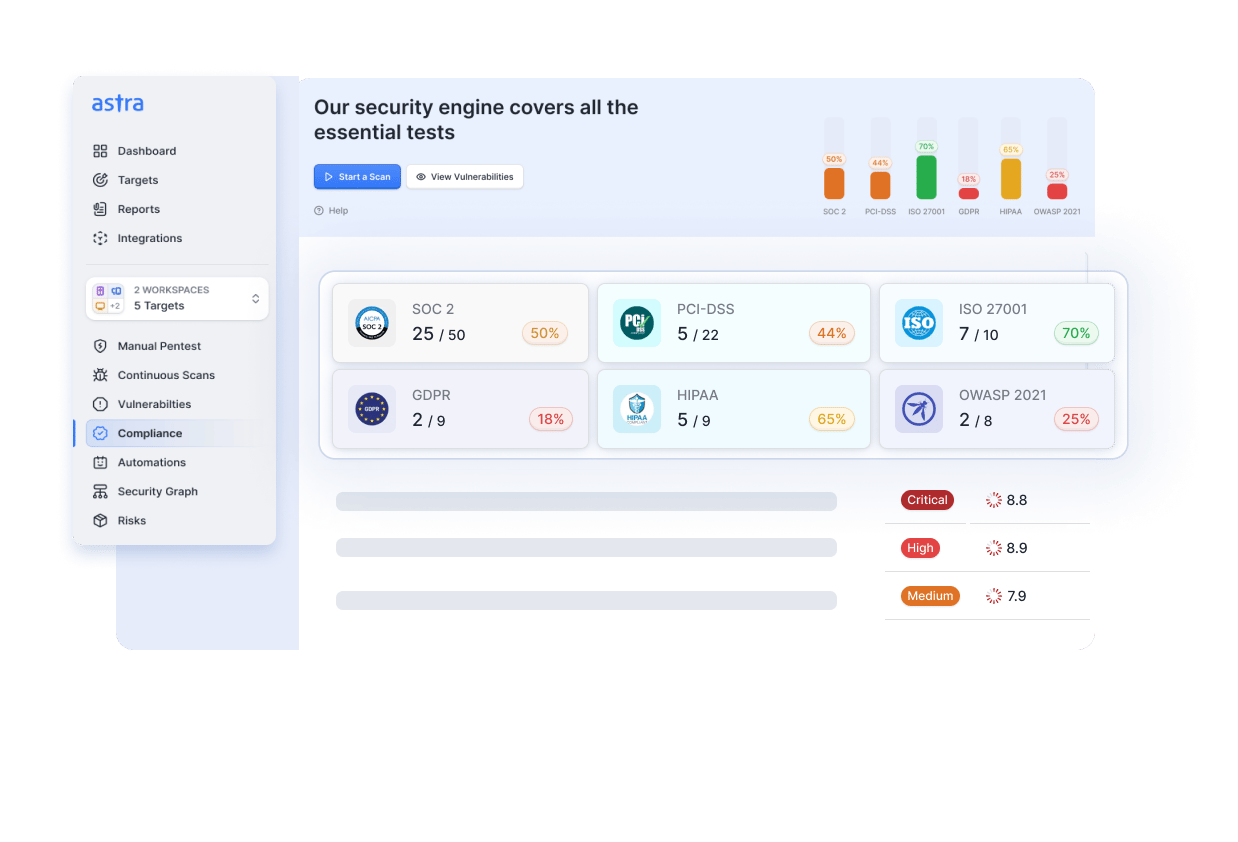
- Extensive Test Coverage: 15,000+ test cases with new ones added every fortnight
- Browser-Based Scanning: Accurate JavaScript rendering
- Authenticated Scanning: Handles modern login flows
- Automatic API Discovery: Finds shadow & orphan APIs
- Manual Pentesting: Uncovers business logic flaws
- AI-Powered Test Cases: Improves fuzzing & coverage
- Continuous Automated Scans: Tests for emerging CVEs
- Seamless CI/CD Integration: Integrates with your pipeline
- Customizable Reporting: Reports for every role
Astra Security’s DAST platform utilizes a headless Chromium engine to render JavaScript-heavy interfaces in a manner that mimics a user’s experience. This means it can navigate client-side routes, trigger dynamic events, and interact with every hidden state your SPA contains: no more blind spots, no more illusion of coverage.
Where most scanners stop at crawling, Astra Security goes deeper by continuously discovering and testing your APIs during real-time interaction. It captures every XHR and fetch request the SPA triggers, mapping hidden endpoints, fuzzing parameters, and flagging issues like broken access control, insecure tokens, and IDORs.
That includes shadow, orphan, and zombie APIs that quietly expand your attack surface. Beyond automation, Astra’s in-house security engineers bring human intelligence into the loop. They simulate real-world attack patterns across your app’s complex state flows, like bypassing role-based logic, escalating privileges, or chaining misconfigurations for lateral movement.
Final Thoughts
Most security teams assume their scanner’s clean report means their SPA is secure, but in reality, that scanner likely never reached 80% of the application. The shift to JavaScript-heavy, API-driven frontends has changed the game, and your security tooling needs to catch up.
SPAs aren’t insecure by design; they’re just invisible to outdated scanners. From dynamic routing to token-based auth and hidden API flows, they require a DAST approach that behaves more like a browser and less like a bot.
Modern security is about surfacing the truth of your application’s risk. That truth resides in the APIs, conditional states, and logic flows that attackers target. If your tools aren’t testing those, they’re just checking boxes.
Astra Pentest is built by the team of experts that helped secure Microsoft, Adobe, Facebook, and Buffer

FAQs
1. Can you run DAST on a React/Angular/Vue.js application?
Absolutely. When DAST products perform authenticated, browser-based crawling and API fuzzing. Tools without real JS execution miss most of the app. Astra Security supports all major SPA frameworks out of the box.
2. How is DAST for SPAs different from API testing?
API testing focuses on contract or schema-based fuzzing, often via Postman or Burp. SPA DAST combines UI navigation, session state management, API fuzzing informed by dynamic user actions, and schema intelligence. It bridges client and server in a single scan.
3. How long does a DAST scan for an SPA take?
Scan time depends on app size and interaction complexity. On average, most companies complete mid-sized SPAs in 15–45 minutes, with deep API fuzzing taking an additional 30–60 minutes. CI/CD integration ensures scans run unobtrusively on every build.