
Key Takeaways:
- Payment gateways are high-value targets, and a single vulnerability can lead to significant financial losses, data breaches, and reputational damage.
- Many companies overlook deep flaws in API behavior, business logic, and transaction flow by relying only on basic scans or compliance checks.
- Hosted, self-hosted, and API-based gateways each have distinct risks that demand specialized testing strategies.
- Comprehensive testing covers more than OWASP issues. It inspects encryption, tokenization, redirect flows, and fraud controls.
- Astra’s hybrid approach combines manual pentests and automated scans to secure modern gateways and simplify PCI DSS compliance.
With global e-commerce transactions projected to exceed $8.1 trillion by 2026, according to Statista, payment gateways are an irresistible target for attackers. A single exploit, like a poorly configured API or insecure redirect, can lead to massive fraud, compliance violations, and irreparable loss of customer trust.
Yet, many businesses still rely on surface-level testing or compliance checklists, missing critical flaws in business logic, API behavior, and payment flow integrations. In this guide, we break down the evolving risks, explore real-world testing approaches, and show you what effective payment gateway security actually looks like in 2025.
What Is Payment Gateway Security Testing and Why Does It Matter?
Security testing of a payment gateway is a specialized form of testing that evaluates the security procedures of online payment systems. This test uncovers security gaps and compliance violations. However, payment gateway testing is more focused and granular than regular web application penetration testing because it is designed to test from a financial, data security, and transaction integrity perspective.
The idea is to simulate real-world attack situations to find security vulnerabilities before threat actors can exploit them. Security engineers examine how payment data flows through the system, validate whether sensitive data remains encrypted, and determine whether authentication mechanisms are functioning as intended.

Why is Astra Vulnerability Scanner the Best Scanner?
- We’re the only company that combines automated & manual pentest to create a one-of-a-kind pentest platform.
- Vetted scans ensure zero false positives.
- Our intelligent vulnerability scanner emulates hacker behavior & evolves with every pentest.
- Astra’s scanner helps you shift left by integrating with your CI/CD.
- Our platform helps you uncover, manage & fix vulnerabilities in one place.
- Trusted by the brands you trust like Agora, Spicejet, Muthoot, Dream11, etc.

What Are the Different Types of Payment Gateways?
1. Hosted Payment Gateways
Hosted payment gateways redirect customers to a page provided by the gateway, where they can complete their payment using a credit card or other accepted payment methods. Famous cases are PayPal, Stripe Checkout, and Square.
Sensitive data is only stored and processed by the payment processor, thereby reducing exposure to PCI compliance requirements. However, companies (users of the payment gateway) still need to secure the integration points and ensure that the redirects function properly.
2. Self-Hosted Payment Gateways
Self-hosted gateways process payments on your servers. This grants you total control of the user experience while adding to security responsibilities. Your servers process payment data, which is sensitive information that you must secure by the PCI DSS.
Since you’re handling sensitive cardholder data, you’re fully responsible for implementing encryption, access control, and secure storage practices. These setups offer maximum branding and UI flexibility, but require a mature security infrastructure and constant threat monitoring.
3. API Hosted Payment Gateways
The API-hosted solutions are a hybrid of the two approaches. Payment information is sent directly to your payment processor via secure APIs, allowing you to maintain control over the checkout process. This decreases PCI scope and adds agility, but means you need to get API security right.
APIs must be rigorously tested for authentication flaws, data leakage, and abuse scenarios, such as replay attacks. Developers must also handle edge cases gracefully and monitor for anomalies across the entire transaction flow.
How is Payment Gateway Testing Different from Regular Application Security Testing?
Security testing on a payment gateway is much different than regular web application testing. Typical application testing is around common security issues like SQLi, XSS, authentication issues, etc. Payment gateway security testing ensures that PCI DSS controls are met, encryption standards are in place, and that the transactions are sound and secure.
Penetration testers review payment flows to ensure card data is never sent to your servers when unnecessary, and they validate that payment tokens are functional. The tests also verify the effectiveness of fraud prevention tools and transaction monitoring systems.
Why is Security Testing on Payment Gateways Important?
1. Financial Risks and Data Breach Costs
Payment gateway breaches can ruin businesses. In 2024, the average cost of a data breach to businesses was $4.88 million, with the financial services sector incurring higher-than-average expenses. More than just sales lost in the short term, companies are also dealing with chargebacks, legal fees, and regulatory fines.
The 2013 Target breach serves as a prime example, resulting in settlements and remediation costs for the firm of $208 million and rising. For small businesses, these monetary damages are often too much to bear. Security testing of payment gateways prevents these disastrous losses by identifying security gaps in these systems before threat actors can exploit them.
There are also indirect costs that businesses suffer from due to payment gateway attacks. Customer acquisition costs rise when trust diminishes, and some customers never return after a security incident has occurred. Insurance costs may increase, and banks may impose additional processing fees or restrictions.
2. Regulatory Compliance Requirements (PCI DSS)
The PCI DSS takes the form of a mandate that requires any business processing credit card data to undergo security testing. Failure to comply can result in fines between $5000 – $100,000 per month (variability depends on monthly processing volume and severity of violation).
The standard also requires you to implement specific security controls, such as encryption, access limitations, and network segregation. Security testing of payment gateways ensures that these controls function as designed and identifies any gaps in compliance.
Test requirements differ by PCI levels. Level 1 Merchants include those with more than 6 million transactions per year, which require on-site assessment by a Qualified Security Assessor. Intermediate-level merchants will be able to complete their self-assessment questionnaires but will still be required to undergo regular security testing.
3. Customer Trust and Business Reputation
Customer trust is the foundation on which e-commerce companies thrive. One payment security incident can ruin years of built trust. Research indicates 65% of customers won’t shop with a company anymore following a data breach.
Today’s shoppers are aware of payment security risks and will select the businesses they deem secure. SSL certificates and compliance badges can improve your conversion rate. On the other hand, security issues are rapidly propagated via social media and review sites, which exacerbate the harm to reputation.
Payment gateway security testing is a method to prevent fraud and performance issues, enabling merchants to maintain trust with their customers. Providing regular testing shows a commitment to preventing our customers’ data from being exposed and can be a selling point when advertising, compared to other businesses.
Different Ways of Doing Payment Gateway Security Testing
| Method | Best For | Strengths | Limitations |
|---|---|---|---|
| Manual Testing | Fraud logic, edge cases, business logic flaws | Deep analysis, uncovers logic bugs, tests real-world scenarios | Time-consuming, depends on tester skill, harder to scale |
| Automated Testing | Fast, repetitive checks across integrations | Scales well, integrates into CI/CD, finds known vulnerabilities quickly | Can miss logic flaws, may produce false positives |
| Compliance Testing | Meeting PCI DSS and regulatory requirements | Audit-ready documentation, validates security controls | Doesn’t find new vulnerabilities, focused on checking boxes |
1. Manual Security Testing
If you’re a CTO at a fintech startup, manual testing for fraud prevention logic becomes even more critical due to layered integrations and high compliance expectations. It involves human experts conducting hands-on security assessments of payment gateways using techniques such as code review, penetration testing, and business logic analysis.
Manual testing is very good at discovering business logic issues (like payment amount manipulation or transaction replay attacks). Penetration testers can identify problems in payment flows, verify that error-handling functions correctly, and test edge cases that automated tools cannot.
On the other hand, manual testing is a labor-intensive task that requires expertise. The quality of manual testing depends significantly on the tester’s level of knowledge and experience with payment systems. Manual testing also does not lend itself to scaling for testing high volumes of payment processing or complex integrations.
2. Automated Security Testing
Automated security testing employs dedicated software scanners to crawl payment gateways, searching for known vulnerabilities. These tools can easily identify common security issues, including poor SSL/TLS configurations, outdated software, and well-known web application vulnerabilities.
Automated scanners are highly effective at performing repetitive tasks, such as scanning all angles or continually verifying that your payment gateway remains operational. They can emulate large transaction volumes, test multiple payment scenarios in parallel, and integrate with development pipelines to continuously validate security.
The primary disadvantage of automated testing is its inability to understand business logic and context-specific vulnerabilities. Automated tools can produce False Positives or overlook subtle attack vectors that humans need to identify.
3. Compliance Testing
Compliance testing primarily confirms adherence to regulations or standards. For payment gateways, this typically involves PCI DSS compliance validation, but may also encompass other rules, depending on the industry and country.
First and foremost, compliance testing is based on strict processes and priorities in producing hard documentation for audit purposes. This type of testing involves verifying whether security controls meet specific requirements, rather than discovering them for the first time.
The PCI DSS is typically validated through formal compliance testing conducted by an external organization, such as a Qualified Security Assessor (QSA). Internal departments can pre-test compliance using self-assessment questionnaires and compliance scanning tools.
Security Testing Methodology for Payment Gateway Testing
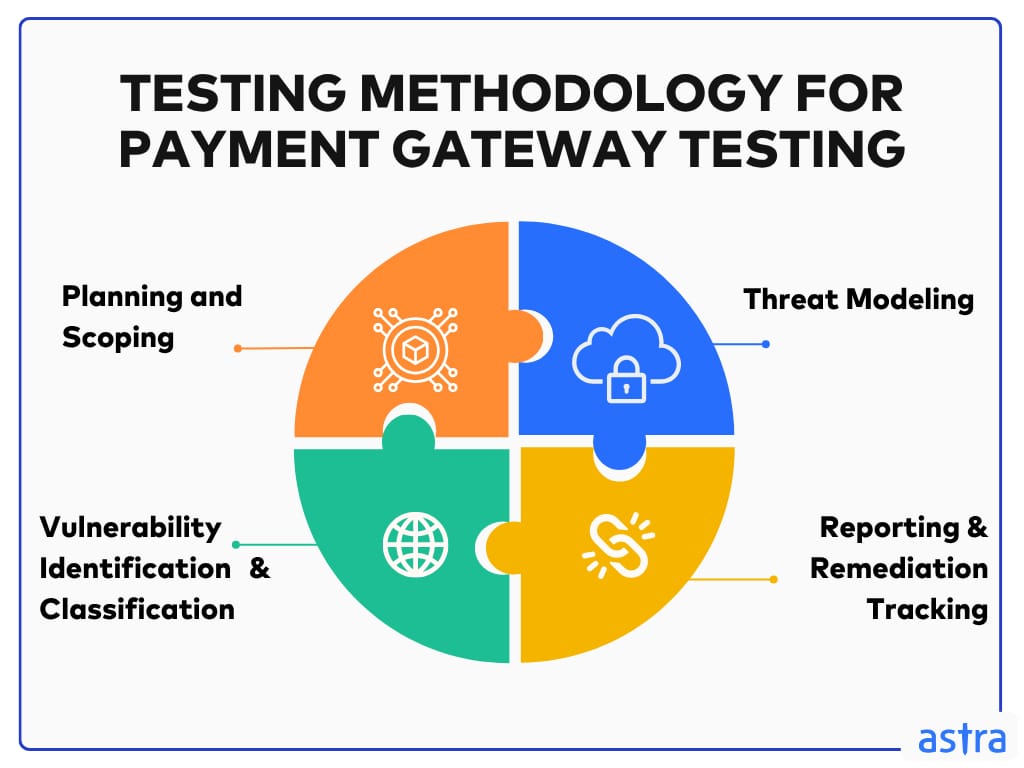
1. Planning and Scoping
Successful testing of payment gateway security starts with thoughtful planning and scoping. Begin by documenting all the components involved in payment processing, such as web applications, APIs, databases, and third-party integrations.
Define testing objectives clearly. Are you testing for PCI DSS compliance, conducting a comprehensive security assessment, or performing routine vulnerability scanning? Different goals require different testing methods and tools.
Establish testing constraints and limitations. Specific payment processors may limit tests or require prior notice. Testing windows can be narrow in production systems to minimize impact on live traffic, and record constraints to keep testing plans grounded and achievable.
2. Threat Modeling
Threat modeling helps you consider how attackers might exploit your payment gateway implementation. Think about who might try to break into your system or network, what they want from it, and how they might try to get what they want.
Typical threats faced by a payment gateway include payment card data theft or transaction tampering, account takeover, and denial-of-service attacks. Each of them requires special testing methodology and mitigation techniques.
Develop attack patterns in your threat model. If, for instance, card information theft is a significant concern, focus testing on data encryption, access control, and data storage security. If transaction tampering is the primary concern, focus on testing the integrity of the payment path and validating transactions.
3. Vulnerability Identification and Classification
Automated scanning techniques cannot perform a systematic vulnerability search alone; manual testing is also required. Leverage computerized scanners to find low-hanging fruit, and run manual testing techniques to identify any hidden business logic vulnerabilities. For a combination of both, try Astra Security.
Sort security issues by risk and relatedness to payment processing. The card-data exposure or transaction manipulation implications of critical vulnerabilities are of immediate concern. The less severe ones can be dealt with as part of maintenance releases.
4. Reporting and Remediation Tracking
Thorough reporting covers all tests, results, and recommendations. Provide technical documentation for developers and executive briefs for business-oriented stakeholders. When actionable recommendations are specific to a vendor, they can directly address a vulnerability in the production environment.
Monitor the resolution of security issues in accordance with change management procedures. Ensure that patches address the root causes of security issues and do not create new problems. After resolving critical vulnerabilities, re-test to verify that fixes are successful.
Keep security testing results over time to compare and track improvements. This evidence also facilitates regulatory audits and demonstrates due diligence in security management.
Payment Gateway Testing Security Checklist
Data Protection and Encryption
- Verify that all payment data transmissions use strong encryption (TLS 1.2 or higher)
- Confirm that stored payment data is encrypted adequately with approved algorithms
- Test that encryption keys are managed securely and rotated regularly
- Validate that sensitive payment data is never stored unnecessarily
- Check that payment data is properly masked or tokenized in logs and databases
Authentication and Access Control
- Test multi-factor authentication for administrative access
- Verify that default passwords have been changed on all systems
- Confirm that access privileges follow the principle of least privilege
- Test session management and timeout mechanisms
- Validate that failed authentication attempts are correctly logged and monitored
Network Security
- Verify that payment processing networks are properly segmented
- Test firewall configurations and access rules
- Confirm that unnecessary network services are disabled
- Validate that network traffic is monitored for suspicious activity
- Test wireless network security if applicable
Application Security
- Test for SQL injection vulnerabilities in payment forms
- Verify protection against cross-site scripting attacks
- Test file upload restrictions and validation
- Confirm that error messages don’t reveal sensitive information
- Validate input validation and output encoding
Transaction Security
- Test transaction integrity and non-repudiation mechanisms
- Verify that duplicate transactions are correctly detected and prevented
- Test payment amount validation and manipulation protection
- Confirm that transaction logs are complete and tamper-evident
- Validate fraud detection and prevention mechanisms
How can Astra Help With Payment Gateway Testing?
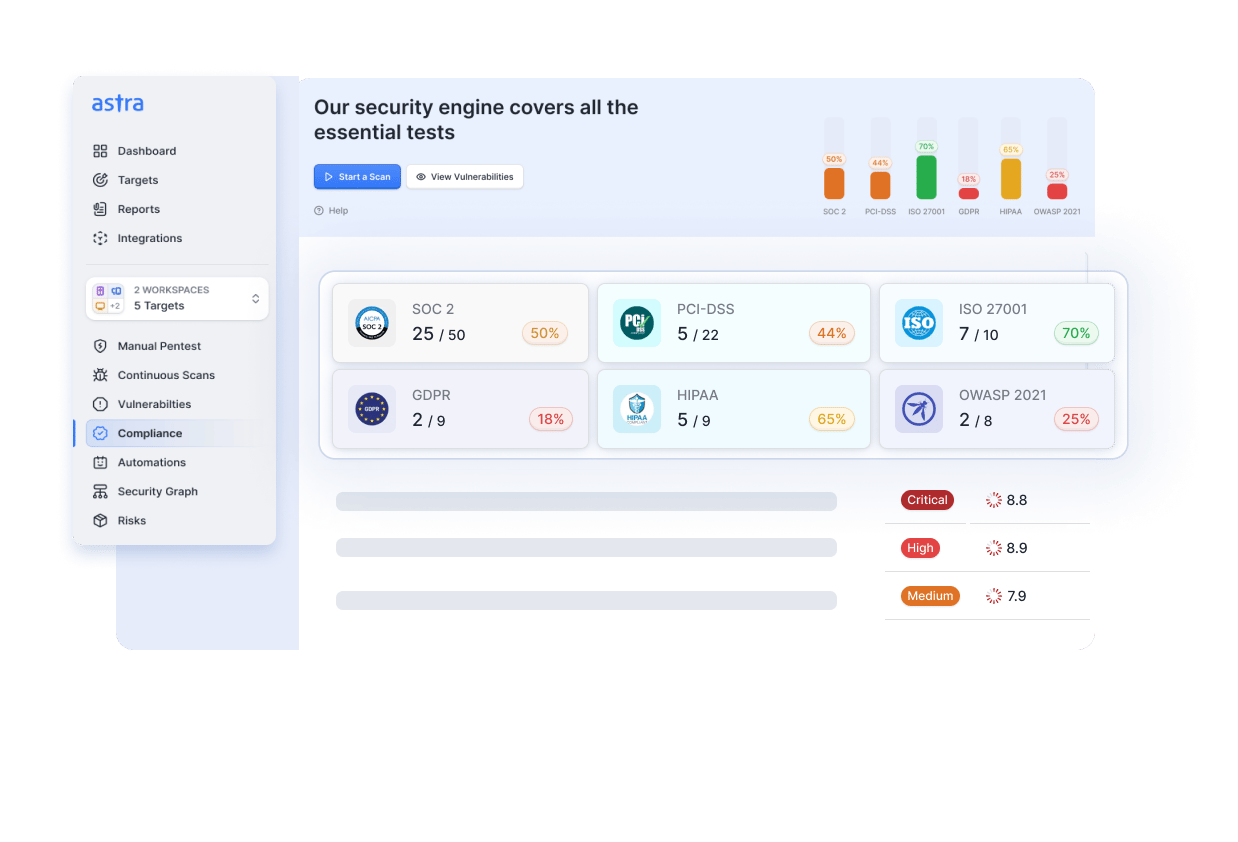
Key Features:
- 15,000+ Test Cases: Extensive automated and manual checks, updated every two weeks
- AI + Manual Expertise: AI-guided logic with expert-led pentests for fraud and logic flaws
- Zero False Positives: Every vulnerability is manually verified by certified researchers
- Behind-Login Scanning: Test complete payment workflows, including authenticated areas
- Compliance-Ready Reports: PCI DSS-focused, customizable outputs for audits and dev teams
- Seamless Integrations: Works with Jira, GitHub, GitLab, Jenkins, Slack, and more
Astra Security offers a comprehensive Payment Gateway Security Testing service tailored for modern e-commerce and fintech businesses. We combine automated vulnerability scanning with manual penetration testing by certified experts to uncover vulnerabilities across payment workflows, whether hosted, self-hosted, or API-based.
Unlike generic scanners, Astra’s methodology is built for transaction-heavy, compliance-sensitive systems. Our expert-led testing ensures that critical areas, like encryption, redirect flows, API authentication, fraud prevention logic, and tokenization, are rigorously assessed.
We tailor our approach to your gateway architecture and stack, ensuring in-depth coverage of integration points, third-party SDKs, and platform-specific risks. Whether you’re a startup CTO navigating layered fintech integrations or a growing e-commerce brand managing customer trust at scale, Astra helps reduce risk and accelerate compliance.
Final Thoughts
Conducting payment gateway security testing is crucial to securing your business and protecting customers from financial fraud and data breaches. When financial risk, regulatory requirements, and customer trust are factored in, security testing becomes a business imperative, not something that can be overlooked.
Successful payment gateway security testing entails knowledge of gateways’ architecture, testing methodologies, and constant security analysis. Conducting appropriate security testing is a worthwhile investment, as it reduces breach risk, preserves customer trust, and mitigates the costs associated with regulatory non-compliance.
Ready to secure your payment system? Contact Us to speak with an expert or explore our Pricing Page for transparent service tiers.
Astra Pentest is built by the team of experts that helped secure Microsoft, Adobe, Facebook, and Buffer

FAQs
1. What are the most significant risks in payment gateways?
The most significant risks associated with payment gateways include poor encryption, insecure redirect flows, misconfigured APIs, and inadequate fraud detection. These vulnerabilities can lead to data breaches, financial fraud, and non-compliance with standards such as PCI DSS if not regularly tested and secured.
2. Is PCI DSS compliance the same as security testing?
No, PCI DSS compliance is not the same as security testing. Compliance ensures minimum security controls are in place, while security testing actively probes systems to uncover hidden vulnerabilities that may be missed by compliance checklists alone.
3. How often should I test my payment gateway?
You should test your payment gateway at a minimum quarterly and after every significant code change, third-party integration, or infrastructure update. Frequent testing helps detect new vulnerabilities and ensures ongoing compliance with evolving security standards, such as PCI DSS.
4. What tools can help with payment gateway testing?
Tools like Astra Security’s testing platform, Burp Suite, and PCI DSS scanners help identify vulnerabilities in payment gateways. They assist in testing encryption, authentication, API security, and compliance, offering both manual and automated coverage for thorough security assurance.