Ask any security engineer what they actually think about their vulnerability scanner, and you will get a version of the same answer. They trust maybe 20% of what shows up in the patching queue. The rest gets a suspicious glance, and a slow death in a backlog.
That is the real cost of a false positive. It is quiet, it compounds, and it hollows the tool out from the inside. It is also the reason autonomous pentesting came to replace hypotheses with confirmed exploits.
Real Cost of False Positives
Every false alarm chips away at how much your team believes the findings. One noisy critical from a scanner that flagged a version string it could not exploit is forgivable. Fifty of them across a quarter, and your senior engineer stops opening the dashboard.
This leads to dangerous findings being statistically buried under the junk. When 90% of your critical alerts are noise, the one that matters is functionally invisible. False positives cause false negatives in practice. Your teams are ignoring it because your tool taught them, through repetition, that criticals are usually nothing.
Studies found that 78% of security teams experienced automated scanning tools missing critical vulnerabilities, i.e., returning false negatives. Confidence in fully automated testing collapsed from 29% to 9% in a single year.
Our State of Continuous Pentesting report is projecting that 1 in 5 findings will be Critical by the end of 2026. Which means if your pipeline is choking on false positives, the odds you miss a real Critical go up fast.
Then there is the human cost, which nobody puts in the board deck. Analysts burn out chasing ghosts. The context-switching tax of validating findings that turn out to be phantoms eats the day. You lose the person who actually understood your environment because they spent months triaging phantom SQL injection alerts on an internal admin panel behind three layers of auth.
Why Scanners Generate Noise in the First Place
Most vulnerability scanners are built on a foundation that guarantees false positives, i.e a breadth-first approach. Breadth comes at the cost of precision. The scanner sees a version number, a dependency, and a response header. It cross-references a Common Vulnerabilities and Exposures (CVE) database and raises a flag. Whether that CVE is actually exploitable in your specific deployment is a question the scanner was never designed to answer.
For example, a scanner identifies Apache 2.4.49 on a target and flags CVE-2021-41773 (path traversal) because the version matches the affected range. It does not check whether mod_cgi is enabled (the prerequisite for RCE), whether Require all denied is set on the affected directory, or whether an ingress controller rewrites the malicious path segments before they reach the server.
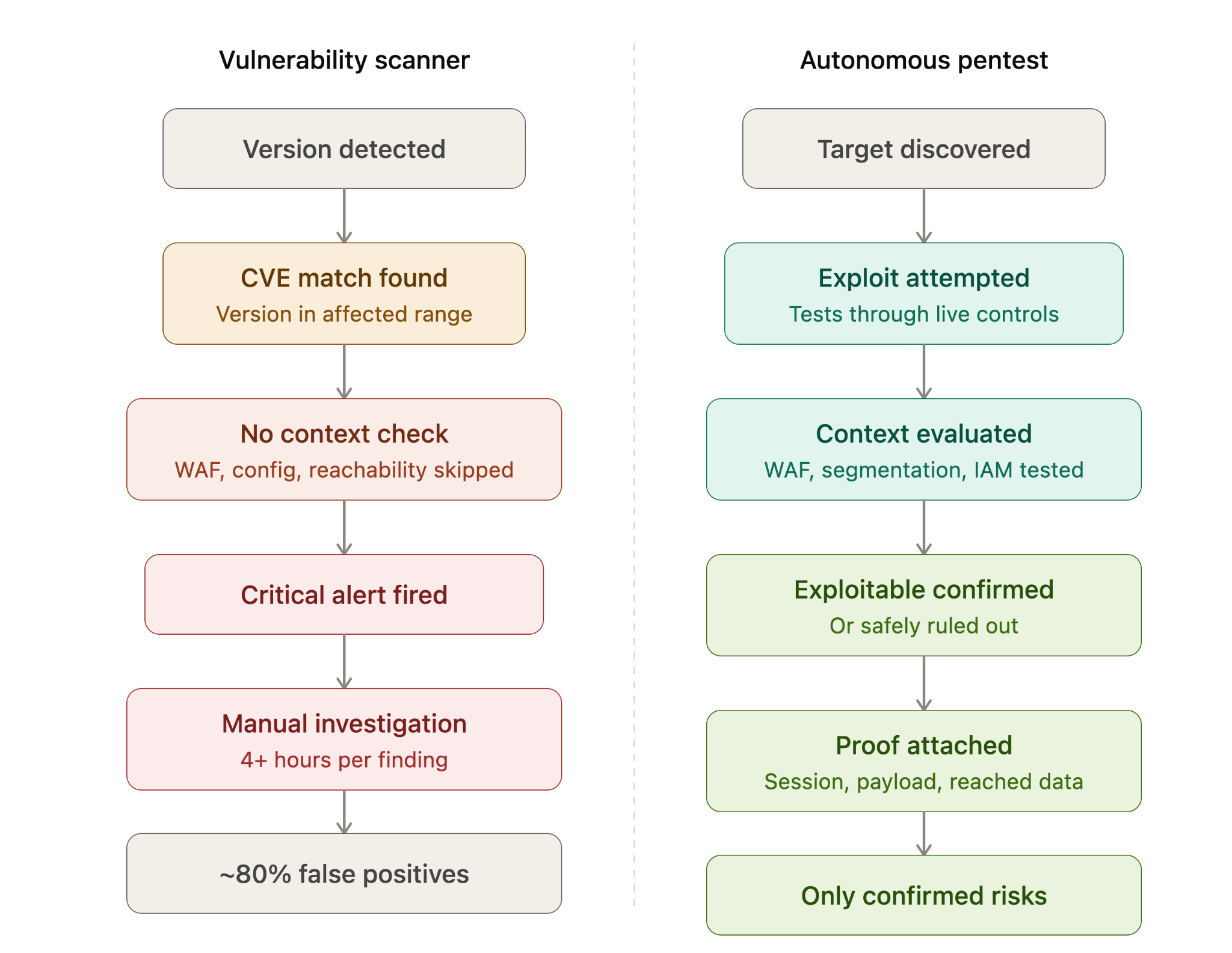
Then this vulnerability is added to the queue as critical. The dev investigates and closes the ticket when mod_cgi is found to be disabled. It happens again in the next scan, and the dev closes it again. By the 3rd or 4th scan, the entire category of vulnerabilities in Apache gets mentally deprioritized.
Now, when a genuinely exploitable Apache misconfig appears months later, it has a higher chance of getting dismissed as a false positive.
Scanners also operate blind to compensating controls. They do not query your Web Application Firewall (WAF) rulesets, your network segmentation policies, or your Identity and Access Management (IAM) configurations. A finding that says “reflected XSS on /search endpoint” ignores the Content Security Policy (CSP) header with a strict nonce-based script-src directive, the HTTPOnly and SameSite cookie flags, and the WAF rule that blocks payloads matching OWASP Core Rule Set XSS patterns.
Detection Versus Validation
A scanner’s output is a hypothesis. It says: “This version may be vulnerable.” An autonomous pentesting platform’s output is a confirmed fact. It says: “We exploited this, and here is what we reached.” That distinction changes everything downstream, from remediation to the relationship between security and engineering.
| Dimension | Scanner (Detection) | Autonomous Pentest (Validation) |
| Output | “This version may be vulnerable” | “We exploited this. Here’s what we reached.” |
| Evidence | CVE ID + version match | Captured session, exfiltrated proof, full attack chain |
| Context awareness | None (ignores WAF, segmentation, IAM) | Tests through your live control stack |
| Reachability | Assumed | Confirmed via actual network path traversal |
| CVSS handling | Raw base score | Environmental score adjusted by exploit success/failure |
| False positive rate | Industry benchmarks: 15-25% for basic scanners | Pre-validated; only confirmed exploits reported |
| Analyst action required | Investigate, reproduce, verify, then prioritize | Prioritize, remediate, verify fix |
What Proof Actually Looks Like
When a finding shows up with proof attached, the debate ends. Most autonomous pentesting platforms now attach screen recordings, screenshots, captured sessions, and full request/response pairs to every confirmed finding. Some vulnerability scanners attach screenshots too, but the screenshot of a version banner or a 200 OK response proves nothing about exploitability. The distinction is what the evidence actually demonstrates.
A scanner screenshot shows: “we detected this response header.” An autonomous pentest screenshot shows: “we used this payload, on this endpoint, and accessed this data belonging to a different user.” The first is a detection artifact. The second is proof of exploitation.
This changes two things immediately. Firstly, it eliminates the time spent analyzing whether a vulnerability actually exists. The investigation step collapses.
Secondly, it accelerates patching. A dev receiving a ticket that says “IDOR on /api/v2/users/{id}/documents, accessed user 4471’s records using user 4466’s session, full request/response attached” has everything needed to reproduce, understand, and fix the issue.
What This Does to Your Workday
Now it collapses patching from days to minutes. The queue is pre-validated, so the question in front of your analyst is no longer “Is this real?” It is “Which of these confirmed risks do we fix first?” That is a fundamentally different cognitive task, and it is the one the analyst was hired to do.
Your remediation list gets ranked by confirmed exploitability. The 9.8 that is unreachable falls to the bottom. The 6.4 that gave the pentesting engine a working path to customer PII goes to the top. The list actually reflects your risk.
And the cultural shift matters more than the workflow one. Your team starts believing the queue again. When findings show up, they get opened. When criticals show up, they get worked. The tool moves from noise generator to trusted input. That trust is what makes the entire security program function.
How to Evaluate an Autonomous Pentesting Platform on False Positives
All autonomous pentesting vendors will tell you their false positive rate is low. The claim is easy to make and difficult to disprove in a sales cycle because most evaluations focus on vulnerability count and severity distribution rather than evidence quality. The right way to evaluate is to stress-test the platform’s validation architecture directly.
Ask questions that force the vendor to demonstrate how findings get confirmed, how noise gets filtered, and how the platform handles the edge cases where scanners historically fail: compensating controls, chained exploits, environment-specific configurations, and findings that look critical on paper but are unreachable in practice.
A platform confident in its validation pipeline will answer these with artifacts. One that pivots to CVSS explanations or detection coverage metrics is telling you something about how it actually works under the hood.
Some of the questions you can raise during your demo to evaluate your autonomous pentesitng
1. Can you show me the exploit session for a critical finding?
Ask the vendor to pull up a confirmed critical from a recent engagement and walk through the evidence (payload used, endpoint targeted, etc).
2. How does the platform handle findings it cannot fully exploit?
This reveals the false positive filtering logic. The right answer involves a validation gate: findings that cannot be confirmed through actual exploitation either get filtered entirely or get flagged at a lower confidence tier with clear reasoning for why the chain did not complete.
3. What happens when a WAF, rate limiter, or segmentation rule blocks an exploit attempt?
A scanner will flag the underlying vulnerability regardless of whether the compensating control stopped it. Ask the vendor whether the platform re-tests through live defensive controls, records which control intercepted the attempt, and adjusts the finding’s risk score accordingly.
4. How does the platform distinguish between a true negative and a false negative?
This is the harder question. Over-tuning to suppress false positives creates the opposite problem: real vulnerabilities get silently dropped. Ask how the platform decides a finding is not exploitable versus deciding it could not determine exploitability.
5. Are reproduction steps generated per finding or templated?
Per-finding reproduction steps that reference the specific endpoint, payload, session context, and attack chain used in your environment mean the platform actually exploited the target and recorded what it did. This is also what determines whether the developer on the receiving end treats the ticket as credible or pushes back with “could not reproduce.”
6. Can the platform demonstrate a finding it initially flagged and then invalidated?
This is the question most vendors are not prepared for. Ask to see a finding that the platform’s validation layer caught and removed before it reached the final report.
If the vendor can show you the adversarial review process, the reasoning for why the finding was invalidated, and the confidence scoring that triggered the filter, the platform has a real validation architecture. If they cannot produce an example, the filtering is either manual, heuristic-based, or nonexistent.
How Astra’s Autonomous Pentesting Solves False Positives
False positives survive because traditional scanners have no mechanism to question their own output. They flag, they report, they move on. Astra’s Autonomous Pentesting is architected to do the opposite: every finding gets challenged before it reaches your queue.
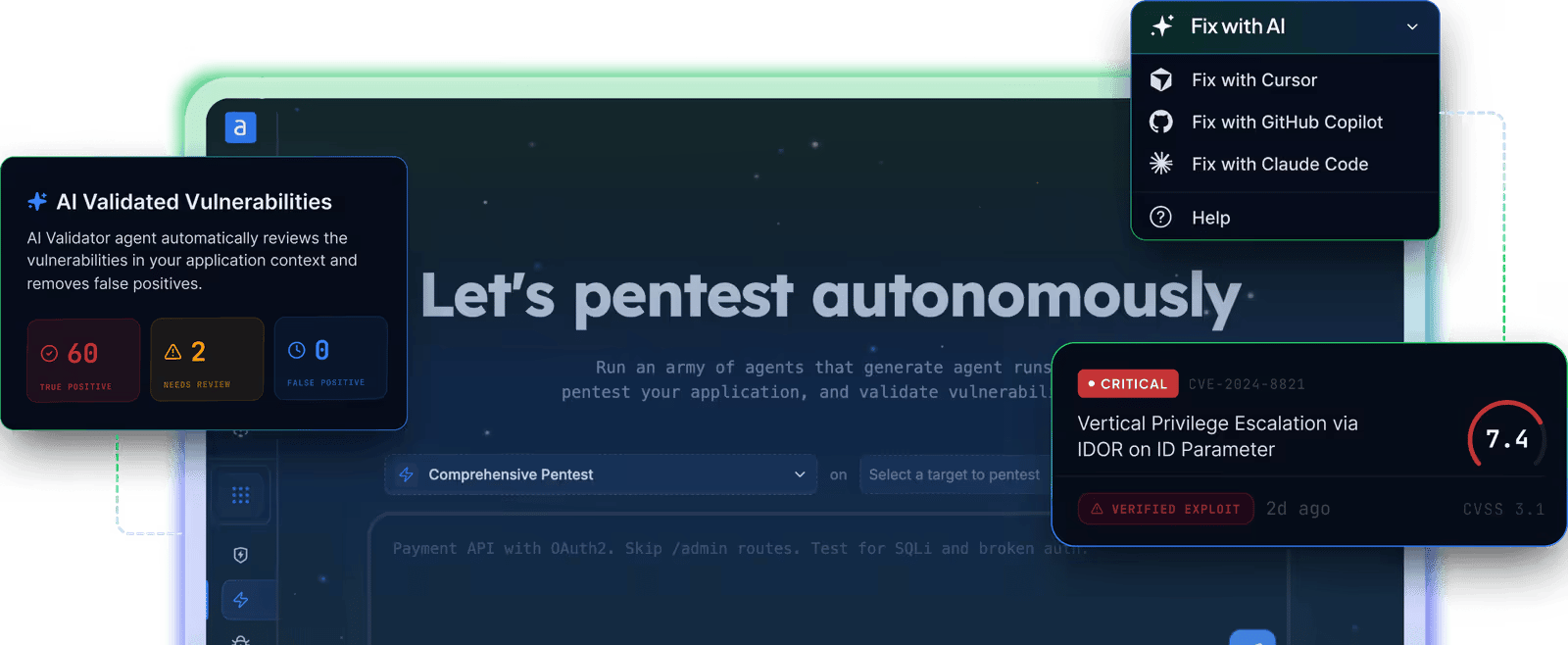
The platform runs two exploitation engines in parallel, each designed to confirm exploitability through actual attack execution. The Structured Pentest generates attack scenarios on the fly from coverage data, running five to six scenarios concurrently. Each scenario is a full attack chain with a description, a complete attack path, and contextual steps to reproduce.
The Bounty Hunter runs alongside and takes the opposite approach. Given more autonomy and direct browser and API access, it targets the highest-value attack path it can identify and goes deep, optimizing for critical vulnerabilities and full-server takeover.
The layer that specifically kills false positives is the Validator. Built on an LLM-as-a-judge pattern, it is a separate set of agents that validates whatever the earlier pipeline reported. Every finding gets re-examined. Each one lands with a confidence score, an outcome, reasoning, and justification for how that outcome was reached.
A finding that cannot survive adversarial scrutiny gets filtered out. If you ask Astra to show you a finding that was initially flagged and then invalidated, the Validator’s audit trail is the artifact that answers that question. That closes the “is this real?” debate before it reaches your team.
Steps to reproduce and steps to fix are tailored per finding. If the agent broke it a specific way in your app, the ticket tells the developer exactly how to reproduce and where to patch. Through Astra’s Fix with AI integration, that context flows directly into Cursor, Claude Code, or GitHub Copilot via MCP, so engineering teams close vulnerabilities without a validation round-trip.
Final thoughts
The scanner model served its purpose when the CVE count was in the low thousands, and a single engineer could verify a week’s findings over coffee. That math broke years ago.
Today, the question is whether your security program makes decisions based on hypotheses or confirmed evidence(autonomous pentesting). One approach generates noise, burns trust, and buries the findings that actually matter. The other validates before it reports and gives your team a queue they can believe in.