Key Takeaways
- Prompt injection now tops the OWASP LLM Top 10, yet most traditional pentest vendors still can’t test the model layer.
- Vendors split by delivery: Bishop Fox, Praetorian and NCC Group embed AI testing in broader red-team or consultancy work, Mindgard and Lakera run continuous automated red teaming, and HackerOne scales through crowdsourced researchers.
- Only a few AI penetration testing companies, including Astra, Mindgard, Lakera and HackerOne, actually test RAG poisoning, agent abuse and MCP boundaries instead of relabeled API checks.
- Astra Security pairs human-led, model-layer pentesting with continuous PTaaS scanning, delivering developer-ready fixes, free re-scans, and mapping to EU AI Act, ISO 42001 and NIST AI RMF within 8-15 business days.
From inchoate brainstorming sessions in the halls of Dartmouth College to a panoply of funding springs and winters, AI has made its way into the tech stack of not just almost every enterprise but also every household. This, though music to the ears of an AI researcher, rewards a security professional with sweat beads.
Even a single AI/ML/LLM or an MCP feature in your product evolves your attack surface, necessitating scouting for the right AI/ML/LLM/MCP penetration testing companies.
The moment an LLM, RAG pipeline, AI agent, or MCP server goes into production, attackers gain a new way in: natural language. And most traditional pentest firms are not built to test it.
This guide compares the top AI pentesting companies and AI red teaming providers for 2026, basically the vendors best equipped to test AI/ML systems, LLM applications, agents, and Model Context Protocol (MCP) servers.
You will get a side-by-side comparison table, a profile of each provider (what they test, strengths, trade-offs, and indicative pricing), a decision framework to match a vendor to your use case, and answers to the AI security questions buyers ask most.
First, why this matters right now:
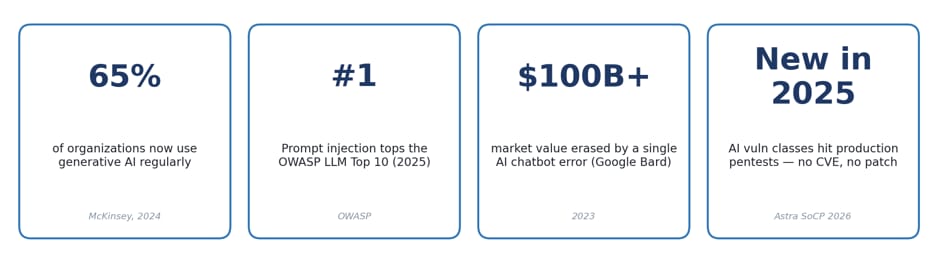
AI security in 2026, by the numbers. (Sources: McKinsey State of AI 2024; OWASP Top 10 for LLM Applications; Astra State of Continuous Pentesting Report 2026).
Adoption has outrun assurance.
Roughly 2 out of every 3 organizations now use generative AI regularly, yet prompt injection sits at #1 on the OWASP Top 10 for LLM Applications and our own 2026 pentest data recorded AI-specific vulnerability classes (prompt injection via API, exposed system prompts) arriving in production pentests for the first time, with no CVE and no vendor patch.
The risk is not theoretical: a single AI chatbot error once erased over $100B from a public company’s market value, and a dealership bot was talked into ‘selling’ a car for $1.
AI pentesting has to cover five layers most web-app tests never touch.
How we Evaluated These AI Pentesting Companies
We ranked these AI and LLM pentesting companies on one question: do they actually test the AI and model layer, or just the app around it? Every vendor here was assessed against the same six criteria for LLM penetration testing, which were applied to our product as well.
- Adversarial depth: real prompt-injection chains, RAG poisoning, agent/tool abuse, and MCP boundary testing, not just API, auth, and OWASP web checks.
- Architecture coverage: how much of the AI stack (LLM, RAG/vector DB, agents, MCP servers, model APIs) the methodology actually reaches.
- Framework alignment: mapping to OWASP LLM Top 10, MITRE ATLAS, NIST AI RMF, and Google SAIF.
- Remediation usability: not just advice but developer-ready findings, reproduction steps, proof-of-concept, and retests.
- Delivery model: point-in-time engagement vs. continuous coverage that keeps pace with weekly model and prompt changes.
- Compliance mapping: alignment to the AI regulations buyers now face (EU AI Act, ISO 42001, NIST AI RMF).
For context, we also drew on Astra’s platform dataset (6.8 million findings across 8,000+ engagements in the State of Continuous Pentesting Report 2026 and each vendor’s public product documentation. As an AI and LLM pentesting provider ourselves, we have kept the criteria objective and let the trade-offs speak for themselves.
Top 9 AI Pentesting Companies Compared
| Company | Best for | AI & LLM testing focus | Delivery model | Indicative pricing |
|---|---|---|---|---|
| Astra Security | AI-as-a-product teams needing model-layer depth + dev-ready fixes | LLMs, AI apps, ML pipelines, MCP; prompt injection, RAG poisoning, agent abuse, extraction | PTaaS: human-led pentest + continuous scanning | Custom for AI; plans from low-thousands/yr |
| Bishop Fox | AI inside a full red-team narrative | AI/ML & LLM assessments within adversarial simulations; Cosmos platform | Red team + continuous offensive | Enterprise, custom |
| NetSPI | AI as one asset in a large cloud/enterprise estate | AI/ML pentesting for off-the-shelf & custom models within apps/cloud | Enterprise PTaaS platform | Enterprise, custom |
| Praetorian | Attacker-realism red teaming | AI feature exploitation chained into realistic attacks; Chariot platform | Offensive engagements | Enterprise, custom |
| Trail of Bits | Deep code & architecture review of custom models | ML/AI assurance; code, dependency & design-level audit | Project-based audit | Project-based, custom |
| NCC Group | Regulated industries & AI governance | AI security within app-sec, risk advisory & governance programs | Consultancy engagements | Enterprise, custom |
| Mindgard | Continuous automated AI red teaming in CI/CD | Automated red teaming of LLMs, agents & multimodal; MITRE ATLAS/OWASP | SaaS platform (DAST-for-AI) | Platform subscription, custom |
| Lakera | Pre-launch LLM testing + runtime guardrails | Lakera Red (adversarial testing) + Lakera Guard (runtime); OWASP LLM | SaaS platform (Red + Guard) | Subscription; free Guard tier |
| HackerOne | Crowdsourced adversarial creativity at scale | AI red teaming by 750+ vetted researchers; jailbreaks, injection, leakage | Add-on / standalone / continuous | Program-based, custom |
Astra Security
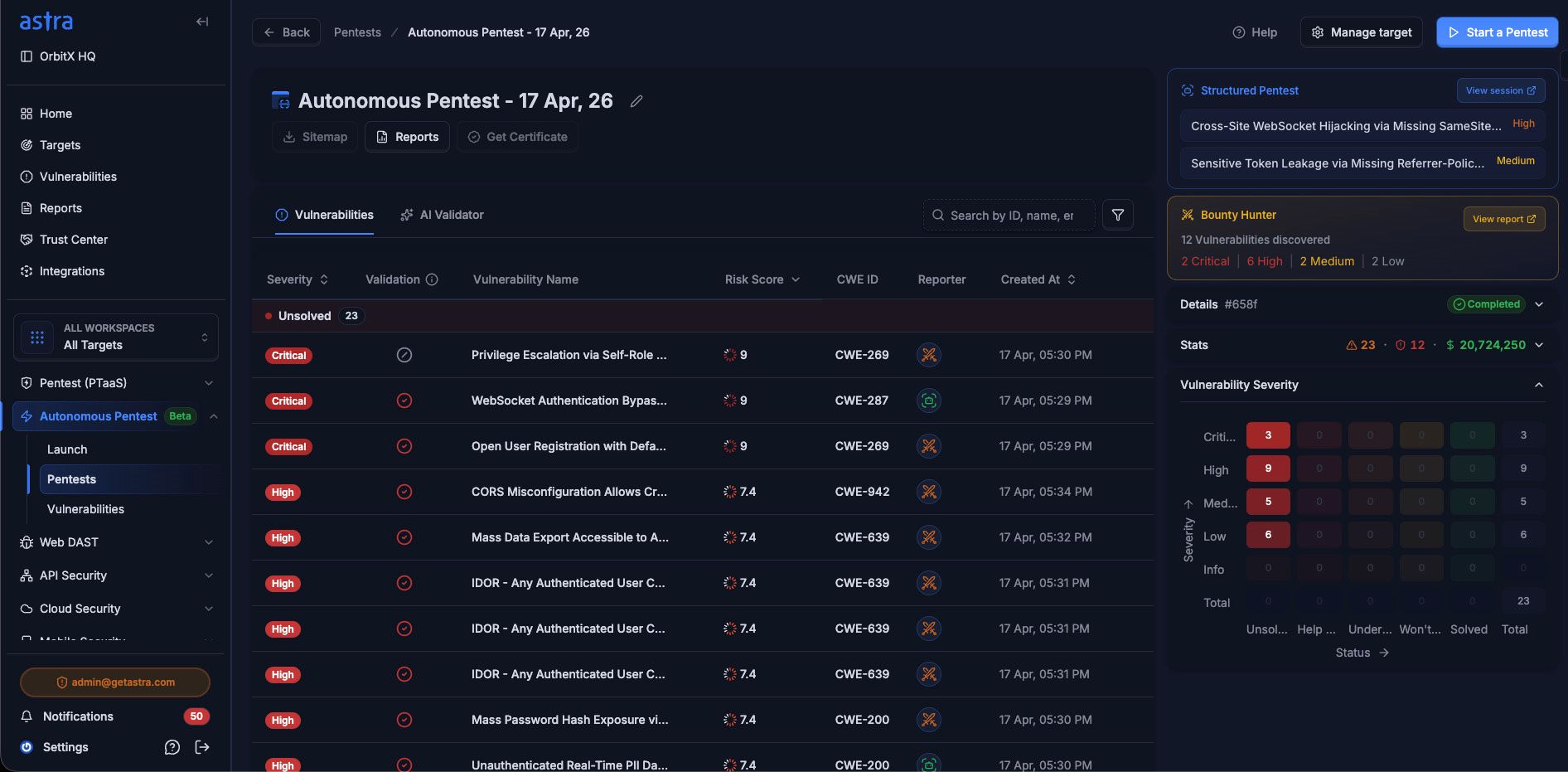
Astra Security pairs human-led, hacker-style pentests with continuous automated scanning purpose-built for LLMs, AI apps, ML pipelines, and MCP servers; all on one PTaaS platform. Where many firms bolt “AI” onto a web-app checklist, Astra’s AI and LLM pentesting tests the model and decision layers directly, then hands engineering something they can act on.
What it tests:
- Direct, indirect, and context prompt injection
- Jailbreaks and guardrail bypass
- System-prompt and PII leakage
- Model extraction and inversion
- Training-data and RAG poisoning
- Excessive agency, tool and agent abuse
- MCP server exposure plus CVE reproduction (SSRF, exposed configs) and the underlying API, auth, and infra.
- Methodology maps to OWASP LLM Top 10, MITRE ATLAS, and Google SAIF.
Strengths:
- 8–15 business-day engagements
- Findings written for engineers with CVSS/DREAD scoring, reproduction steps, video PoCs, and fix guidance
- 2 free re-scans
- A publicly verifiable pentest certificate and Trust Center
- 15,000+ evolving automated tests with zero false positives (every finding human-verified) by OSCP/CEH/eWPTXv2 experts
- Same-platform secret scanner, DAST, and API security.
- CREST-approved, CERT-In empanelled, and a PCI DSS ASV, with mapping for EU AI Act, ISO 42001, NIST AI RMF, SOC 2, ISO 27001, HIPAA, PCI DSS, and GDPR.
Consider if:
- The depth is more than just a compliance checkbox
- You are a burgeoning SaaS and product company envisioning a global enterprise infrastructure.
Best for: Companies shipping AI as a product feature that need model-layer validation, developer-ready remediation, and continuous coverage before procurement or audit, the core AI and LLM pentesting use case.
Indicative pricing: Talk to our experts and register for a demo within minutes!
Bishop Fox
Bishop Fox is an offensive-security heavyweight and one of the more established AI and LLM penetration testing companies, known for deep red-team operations.
Its AI/ML and LLM security assessments, backed by the Cosmos continuous offensive platform with human-on-the-loop validation, usually arrive inside broader adversarial simulations that chain prompt abuse into infrastructure compromise.
What it tests:
- Prompt injection within live environments
- AI system manipulation during red-team campaigns
- Tool misuse as part of lateral movement, and model exploitation tied to auth bypass or infrastructure compromise
Strengths:
- Elite exploit development and attacker realism
- Strong when AI risk must be demonstrated to a board through an end-to-end attack narrative
- Continuous offensive coverage across large portfolios.
Consider if:
- Structured AI-layer coverage (RAG, MCP boundaries, prompt-hierarchy analysis) must be explicitly scoped
- Expect enterprise lead times and pricing
Best for: Mature organizations that want AI and LLM pentesting evaluated as part of a full adversarial simulation.
Indicative pricing: Enterprise-tier, fully custom-scoped.
NetSPI
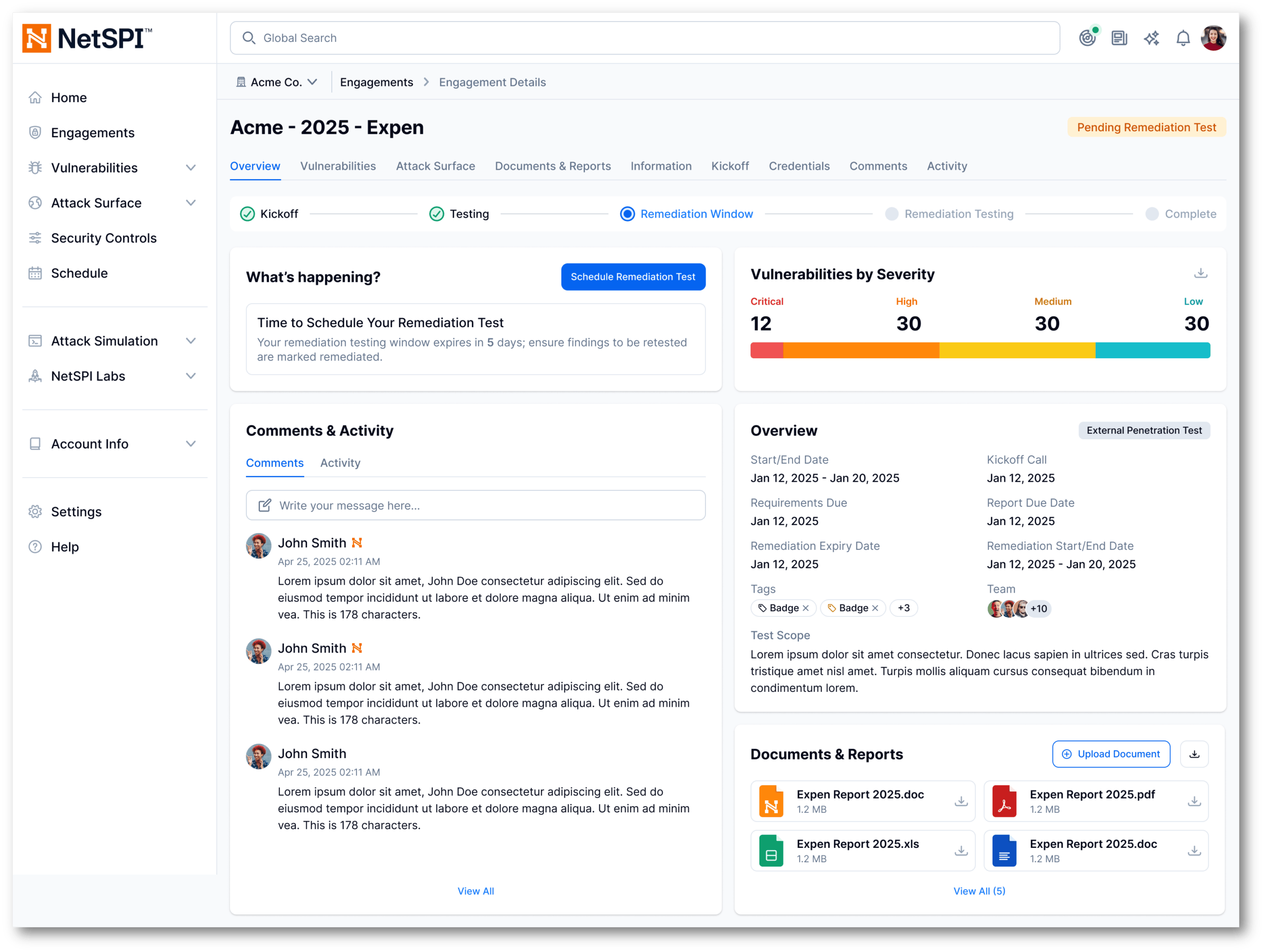
NetSPI delivers enterprise-focused penetration testing across apps, cloud, and infrastructure, with a dedicated AI and LLM penetration testing offering. It tests off-the-shelf and custom models plus LLM functionality inside your applications and cloud, delivered through a real-time reporting platform with Jira and Azure DevOps integrations.
What it tests:
- Application-level testing of AI endpoints
- Validation of AI integrations within cloud
- Authorization-boundary testing for AI features
- General misuse testing of AI workflows
Strengths: Scalable enterprise delivery; AI tested alongside cloud and application infrastructure; standardized reporting that fits centralized GRC dashboards.
Consider if:
- Prompt-hierarchy or RAG-specific exploit depth needs explicit scoping
- The focus is broad rather than AI-specialized
Best for: Large, multi-asset enterprises that fold AI and LLM pentesting into a wider security program.
Indicative pricing: Custom enterprise pricing, aligned with broader pentesting programs.
Praetorian

Praetorian is an offensive-security firm with a strong adversarial culture and a dedicated AI and LLM penetration testing service. Its AI feature exploitation is woven into realistic attack chains and backed by its Chariot platform.
What it tests:
- Prompt manipulation within red-team exercises
- AI feature exploitation during attack chaining
- Authorization-bypass testing in AI-enabled workflows
- Multi-layer exploit simulation
Strengths:
- A strong attacker mindset for realistic scenarios
- Capable of chaining AI abuse into broader system compromise
- Experienced across modern application stacks
Consider if:
- Your scope defines your AI-specialization depth
- You require a structured framework alignment (may need to be requested— requires a mature internal remediation setting.
Best for: Teams that want AI and LLM pentesting delivered as part of an attacker simulation.
Indicative pricing: Custom enterprise engagements.
Trail of Bits
Trail of Bits is an independent security research and engineering firm that has set out to raise the bar for the whole field— not just for the client in front of it. Its reputation rests on deep code- and architecture-level review rather than surface-level scanning. Among AI and LLM pentesting companies, it sits at the deep-research end of the spectrum.
They examine AI systems end-to-end, from training data and MLOps pipelines to model artifacts, inference hardware, and deployed agent loops, and even publish MCP security guidance through their mcp-context-protector project. Moreover, every finding is human-validated, explained in context, and shipped with leave-behind CI guardrails.
What it tests:
- Low-level code analysis
- Model integration review
- Cryptographic and dependency auditing
- System-integrity validation
Strengths:
- High technical rigor suited to novel or complex AI infrastructure
- Can audit AI integrations at the code and dependency level
- Ideal for custom-built systems
Consider if:
- Fewer extensive adversarial prompt-injection campaigns
- Reports assume strong internal engineering maturity and lighter compliance packaging
Best for: Security-mature teams building custom AI infrastructure where architectural integrity is the priority, a niche among AI and LLM penetration testing companies
Indicative pricing: Scoped individually and priced on technical depth.
NCC Group

NCC Group is a global cybersecurity consultancy serving regulated industries and enterprise clients. It offers AI security within broader application security, risk advisory, and governance programs, with a focus on framework alignment and audit-ready documentation. Among AI and LLM penetration testing companies, it is a strong pick for regulated, audit-driven programs.
What it tests:
- AI risk assessment aligned with governance frameworks
- Model-usage and data-flow review
- AI integration testing within app-sec programs
- Policy/control validation for AI deployments
Strengths:
- Strong governance and regulatory alignment
- Audit-ready control documentation
- Global delivery capacity.
Consider if:
- May not deeply simulate adversarial prompt chaining or multi-step model exploitation
- Cadence can be slower than SaaS timelines.
Best for: Regulated or public-sector organizations where AI governance and global capacity are the primary drivers.
Indicative pricing: Custom enterprise pricing, often bundled with risk advisory.
Mindgard

Mindgard is an AI-native, automated AI red teaming platform, effectively a DAST-for-AI, spun out of more than a decade of Lancaster University research.
It continuously probes LLMs, AI agents, and multimodal models with thousands of attack scenarios mapped to MITRE ATLAS and OWASP, catching runtime-only flaws that pre-deployment scanning misses. It is built for continuous AI and LLM pentesting rather than a one-off review.
What it tests:
- Prompt injection
- Jailbreaks and model manipulation at runtime
- A reconnaissance module that maps guardrails, system prompts, tools, and integrations
- CI/CD and Burp Suite integrations across the AI pipeline
Strengths:
- Continuous, automated red teaming wired into the AI SDLC
- Model-agnostic engine
- Deep research pedigree (11 PhDs on staff)
- SOC 2 Type II certified
Consider if:
- Platform-led automation rather than a bespoke human red-team narrative
- Best paired with an in-house team and framework in place
Best for: Teams that want continuous, automated AI red teaming integrated into build pipelines.
Indicative pricing: Platform subscription, custom-quoted
Lakera
Lakera is an AI-native security platform (acquired by Check Point in 2025 in a deal reported near $300M). Lakera Red runs automated adversarial testing against LLM apps pre-launch, while Lakera Guard adds real-time runtime protection, which is a coherent test-then-defend story from one vendor.
Findings are structured around the OWASP LLM Top 10, and the team is known for the Gandalf prompt-injection dataset.
What it tests:
- Automated adversarial scenarios covering direct and indirect prompt injection and jailbreak classes against LLM applications
- Runtime blocking of the same exploit classes in production
Strengths:
- Unified pre-launch testing and runtime defense
- Deep prompt-injection and jailbreak coverage
- Large real-world attack dataset behind the models
Consider if: Strongest when you also adopt Guard; a product/platform relationship rather than a bespoke services engagement.
Best for: GenAI teams that want AI and LLM pentesting plus runtime guardrails from a single vendor.
Indicative pricing: Platform subscription (Red + Guard); Guard offers a free community tier; custom-quoted.
HackerOne
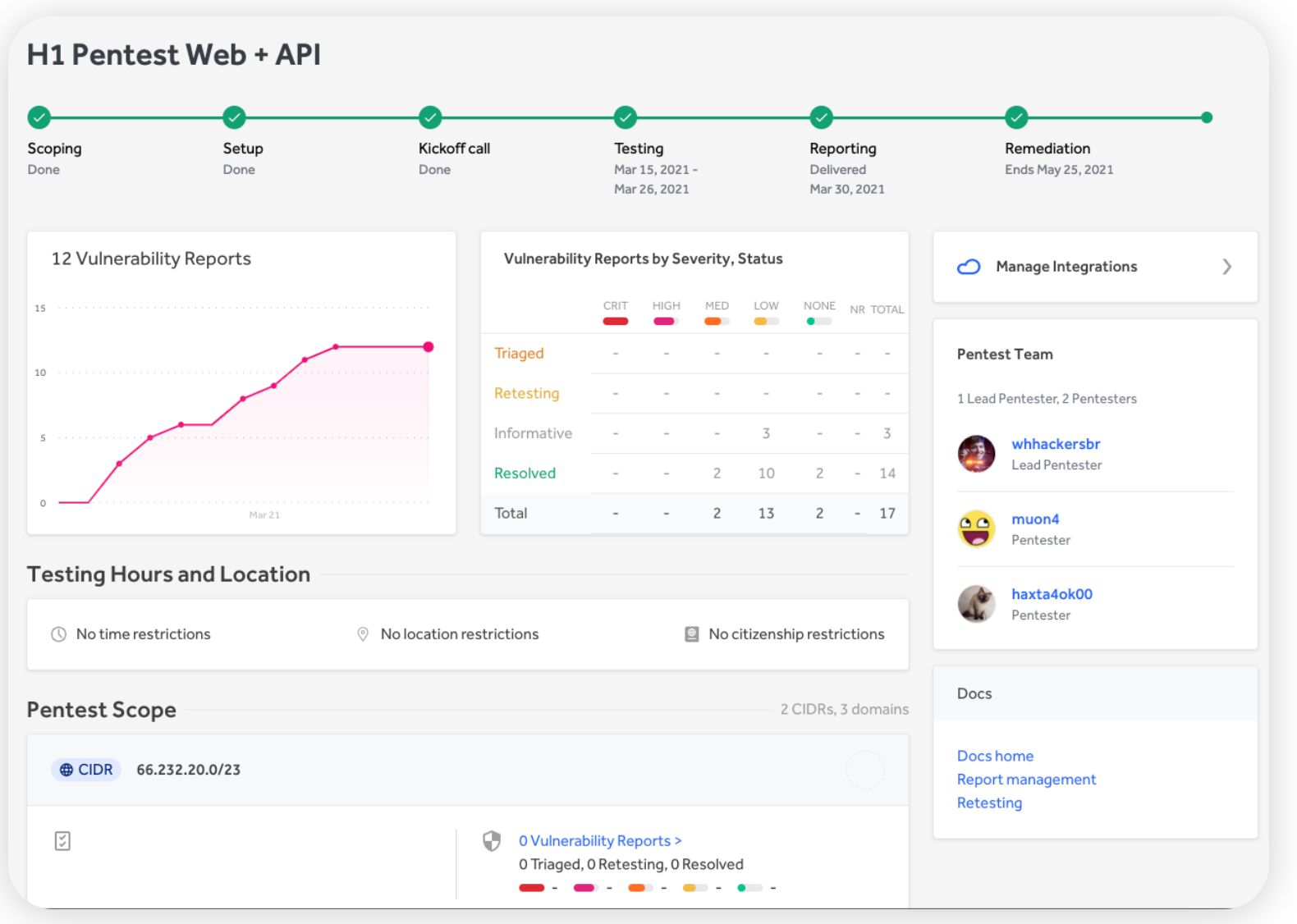
HackerOne brings crowdsourced scale to AI and LLM pentesting. Its H1 AI Red Teaming taps 750+ vetted AI researchers to simulate jailbreaks, prompt injection, cross-tenant data leakage, and unsafe outputs across models, retrieval pipelines, tools, APIs, and agent workflows, with clients such as Snap and Adobe.
What it tests:
- Structured AI/LLM pentests plus creative red teaming, available as an add-on to app/API tests
- Standalone assessment, or continuous AI assurance blending scheduled red teaming
- Bug bounty
- Automated drift monitoring
Strengths:
- Advanced researcher breadth and creativity
- Continuous discovery
- Findings auto-mapped to OWASP LLM Top 10, CWE, MITRE ATLAS, NIST AI RMF, and the EU AI Act
Consider if: The crowd model means variability in coverage depth, and it rewards mature internal triage.
Best for: Organizations that want crowdsourced adversarial creativity and continuous discovery at scale.
Indicative pricing: Program-based (add-on, standalone, or continuous), custom.
Framework to Pick the Best AI and LLM Pentesting Company for You
Most “how to choose” advice regarding AI and LLM pentesting companies is generic (“consider your budget and timeline”). We’ve tried to offer a more opinionated version, built from what actually goes wrong in AI engagements:
- Start from your architecture, not the vendor’s brochure. Map which of the five layers you actually run: LLM, RAG/vector DB, agents, MCP servers, model APIs. A vendor strong on prompt testing but blind to MCP boundaries leaves your fastest-growing surface untested.
- Separate “AI-augmented” from “AI-native.” Some firms use AI to speed up traditional testing. You want an AI and LLM pentesting firm that tests the AI itself. Ask which one they mean.
- Demand adversarial proof, not a framework checklist. Ask for a sample prompt-injection chain, a RAG-poisoning scenario, and an agent tool-abuse PoC. If scoping only produces “we’ll test your APIs and OWASP Top 10,” that is basically web testing with an AI label.
- Decide point-in-time vs. continuous. Models, prompts, and tools change weekly. A one-time test is more of a snapshot. If you ship AI features continuously, you need continuous coverage.
- Match remediation to your team’s maturity. Research-grade audits assume high internal capability, as product teams usually need reproduction steps, PoCs, and retests they can hand straight to engineering.
- Map to the regulations you will actually face. EU AI Act, ISO 42001, and NIST AI RMF are becoming table stakes in security reviews. Confirm your AI and LLM pentesting vendor maps findings to them.
| Traditional risk | AI-specific analogue | What it looks like in practice |
|---|---|---|
| SQL injection | Prompt injection | Crafted language makes the model ignore its instructions or reveal hidden data |
| Broken access control | Agent tool abuse | An AI agent is coaxed into calling internal tools or APIs it should not touch |
| XSS / data exposure | System-prompt leakage | The model is talked into revealing hidden instructions or internal config |
| Input-validation failure | RAG data poisoning | A malicious document enters the vector database and alters model responses |
| Privilege escalation | Role-boundary bypass | The model acts outside its intended permission scope |
| API abuse | Indirect prompt injection | The model follows instructions hidden in external content it retrieves |
| Data leakage | Model-response exfiltration | Sensitive data surfaces through context bleed or retrieval overlap |
Final Thoughts
AI has become part of your product, and thus, now part of your attack surface. The right partner is the one that tests the model and decision layers with genuine adversarial depth, maps findings to the frameworks your buyers ask about, and hands your engineers something they can fix.
If AI is core to what you ship, start with a provider built for it. Astra’s AI and LLM penetration testing combines human-led, model-layer testing with continuous PTaaS coverage, developer-ready remediation, and a shareable certificate to prove it.
FAQs
What is AI and LLM pentesting?
AI and LLM penetration testing is attacking an AI-enabled system the way a real adversary would, at the model, data, and decision layers. It targets AI-specific failure modes such as prompt injection, jailbreaks, RAG poisoning, model extraction, and agent/tool abuse.
How is AI and LLM pentesting different from traditional pentesting?
Traditional pentesting tests code paths; AI and LLM pentesting tests decision paths. In a classic app, the inputs are parameters and form fields, so testing looks for injection, broken access control, and misconfiguration. In an AI app the input is natural language, and that language can be manipulated to leak data, alter behavior, or trigger unintended actions— without a single line of exploit code.
What is prompt injection testing?
Prompt injection is an attack where malicious input causes an LLM to ignore its instructions and act on the attacker’s, conceptually similar to SQL injection, but aimed at the model’s instruction-following behavior.
Which companies offer AI red teaming services?
Among the AI and LLM pentesters in this guide, dedicated AI red teaming is offered by Astra Security (human-led adversarial pentests plus continuous scanning), HackerOne, Mindgard, and Lakera, Bishop Fox, Praetorian, NCC Group (governance-aligned assessment), and Trail of Bits.
Can traditional pentesting vendors test LLM applications?
Partly. A traditional vendor can absolutely test the applications—the APIs, authentication, and infrastructure—so it still matters. What most are not built for is the model layer: prompt-injection chains, RAG poisoning, agent tool abuse, and MCP boundary testing. Look for explicit, adversarial AI and LLM pen testing methodology and framework mapping to OWASP LLM Top 10 and MITRE ATLAS.
What is MCP security testing?
The Model Context Protocol (MCP) is the emerging standard that lets AI agents connect to external tools, data sources, and services. MCP security testing evaluates those connections.