Key Takeaways:
- Manual depth beats “manual testing” on a website, as that’s what separates a real pentest from a scan with a logo on it.
- Only Astra, BreachLock, Software Secured, and NetSPI run true continuous PTaaS; all the other web app pentesting service providers are point-in-time, no matter how often you rebook.
- Authenticated testing and named API scope aren’t optional, as most real risk lives behind the login.
- Budget $5K–15K for a small web app, $8K–25K for SOC 2 scope, $20K–120K/year for continuous PTaaS on average.
Shopping for a web app pentest is confusing on purpose. Every vendor on your shortlist says the same things (“manual testing,” “OWASP coverage,” “audit-ready report”), yet what you get back ranges from a deep, exploit-driven engagement to a scanner export with a logo on it.
If you are a CTO, founder, or security lead trying to compare web application penetration testing companies without a security background to lean on, the hard part is not finding providers. It is figuring out what each one actually sells.
So this guide flips the usual listicle. First, we decode the services a web app penetration testing provider can offer, in plain language. Then we profile 9 providers and fill in a fixed Services Card for each, including our own service at Astra, scored as honestly as everyone else. Finally, we map providers to services in one grid and help you match the service you need to the company that leads on it.
One promise up front: where we are weaker than a competitor, we say so. A list that only flatters the host is an ad, and you would be right to ignore it.
9 Web App Penetration Testing Providers (2026)
- Astra Security
- Breachlock
- Software Secured
- NetSPI
- Bishop Fox
- HackerOne
- Synack
- NCC Group
- Rhino Security Labs
What Web App Penetration Testing Providers Offer
These form the basics and also your basis of evaluation, and without understanding these subjects or concepts, provider profiles in the next section can cease to make sense.
- Vulnerability assessment vs. penetration testing (VAPT): A vulnerability assessment is an automated scan that lists possible issues. A penetration test is a human trying to exploit them to prove real impact. This is the single most important distinction. Many “pentests” you are quoted are mostly the former with a few manual checks on top.
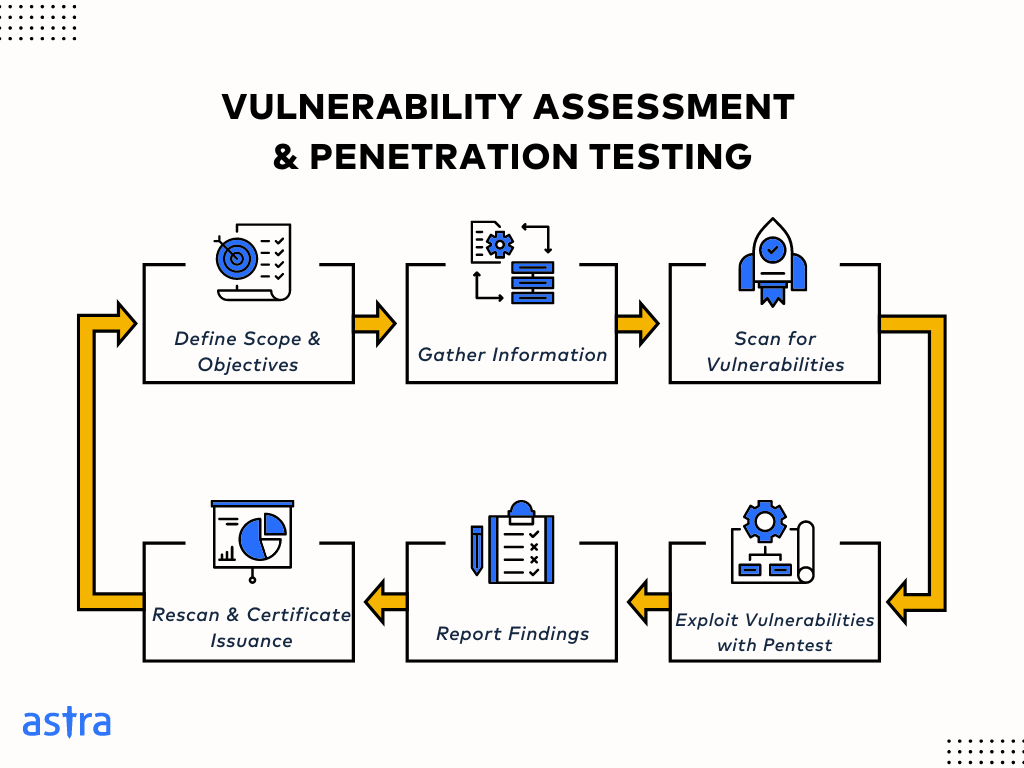
- Black-box, grey-box, and white-box testing: These define the attacker’s starting point. Black-box shields all inside access (attacker’s view). Grey-box involves partial access, generally a login (the most common and cost-effective choice), and White-box allows for full visibility and may include the source code as well.
- Authenticated vs. unauthenticated testing: Unauthenticated testing only hits your public surface. Authenticated testing logs in and tests what happens behind your login, where most of your real risk lives. If a quote does not mention credentials, ask.
- Point-in-time pentest vs. PTaaS: A point-in-time pentest is, as the name suggests, a one-time engagement, i.e., a single report. PTaaS (penetration testing as a service), on the other hand, delivers continuous testing via a platform and is wired into your release cycle; this ensures that new features get tested as and when you ship them.
- API and modern-stack testing: REST and GraphQL APIs, single-page apps, auth tokens, and SSO behave differently from a classic server-rendered site. Daft providers test these natively while many others scope (and price) API testing separately, so confirm if it is in your statement of work or not.
- Business-logic testing: Multi-step abuse, broken object-level authorization (IDOR/BOLA), broken access control, and workflow flaws that no scanner can find because they require a human to understand how your app is supposed to work. This is where good manual testing earns its fee.
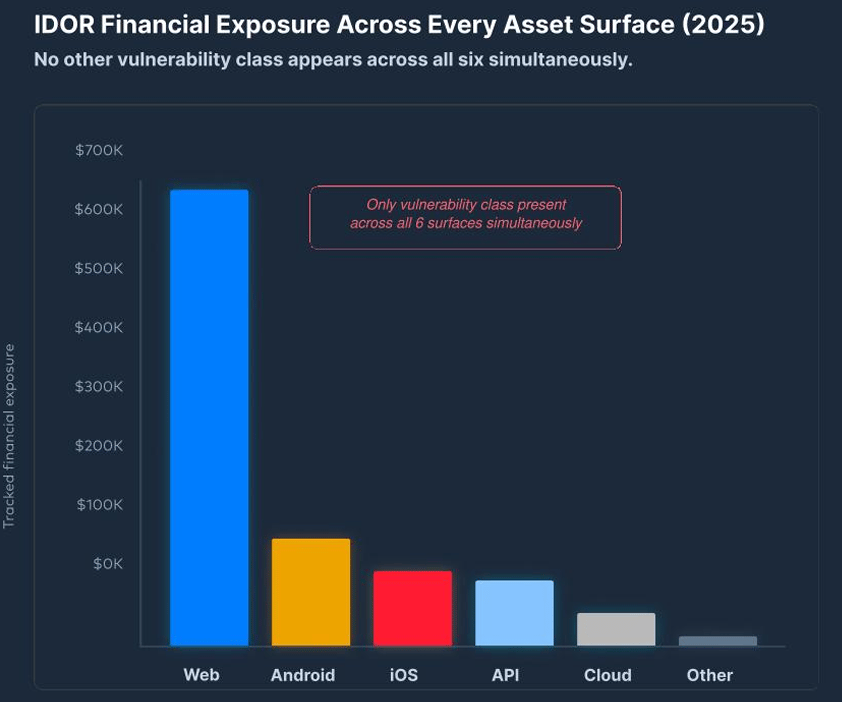
Note: For more such impactful insights and to ask your security provider the right questions, check out our continuous pentesting report 2026.
- Source-code-assisted testing: Combining manual testing with a read of your source (and sometimes SAST tooling) for deeper coverage. Useful when you want maximum depth and are comfortable sharing code.
- Compliance-driven testing: Engagements scoped to satisfy SOC 2, PCI DSS, ISO 27001, or HIPAA, including the attestation letter or certificate your auditor or enterprise customer actually wants to see. For many buyers, this is the real reason for the test.
- Remediation support and retesting: Fix guidance after the findings, plus re-validation once you patch. Retesting is frequently an upsell, so check whether it is included, capped, or billed separately. It matters for compliance, as auditors expect proof that the fix worked.
- Add-ons: Red teaming, social engineering, mobile, network, and cloud testing. Some providers bundle these, others sell them as separate engagements.
The Top Web App Pentesting Vendors
We have tried to present these companies in a services card format that is identical for every entry. They are profiled approximately in order of relevance for a product team in its growth stage, and then we’ve bought enterprise, crowdsourced, and boutique options under the umbrella.
Astra Security
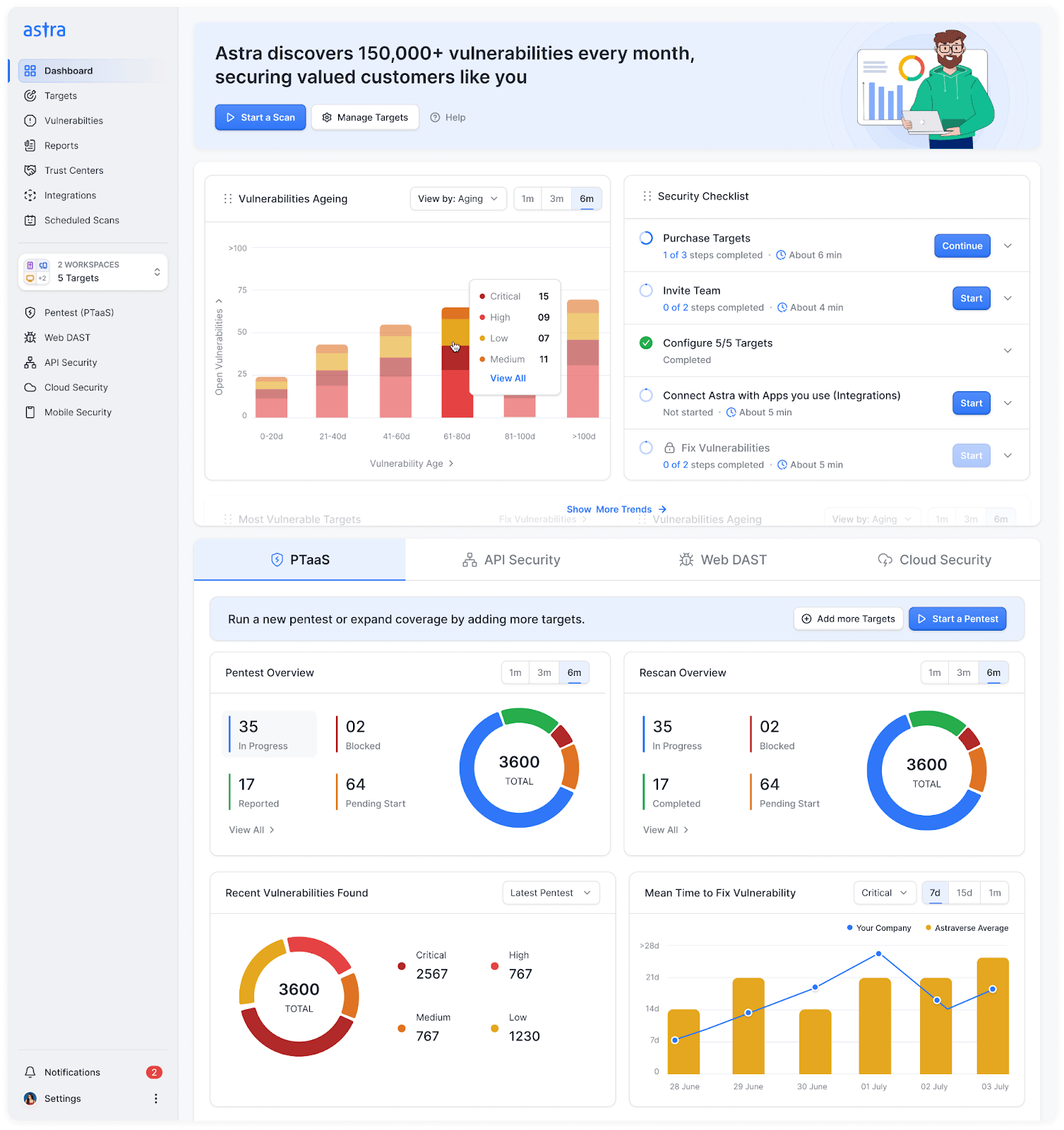
We’ll keep this candid. We’re a PTaaS platform built for web application security with dedicated scanners (15,000+ test cases, vetted to cut false positives) paired with manual testing from OSCP, CEH, CCSP-certified pentesters who actually understand how web apps break: broken auth, IDOR, business logic flaws, the stuff scanners walk right past.
Last year, that combination helped prevent $2Bn+ in losses, with over $21Mn of that coming from manual pentests alone.
We’ve also helped build and sanitize the autonomous pentesting space by co-developing the OWASP APTS document and launching our own autonomous pentesting tool with 3 layers of agents built on insights from 5K+ pentests.
- Best at: Continuous web and API testing that blends scanner coverage with manual validation, plus a verifiable certificate, at transparent pricing.
- Services offered: VAPT manual + automated (✓), authenticated testing (✓), PTaaS/continuous (✓), API testing (✓), business logic (✓), compliance/attestation (✓, verifiable certificate), source review (limited, scoped separately), remediation guidance (✓), retesting (✓, two manual rescans plus unlimited automated rescans).
- Testing style: PTaaS platform, scanner-led with manual validation on top.
- Stack coverage: Classic web, SPA, API; mobile, network, and cloud available on the platform.
- Best-fit buyer: Startups and growth-stage SaaS that ship often, need SOC 2 / ISO / PCI evidence, and want a dashboard, dev integrations, and a certificate without enterprise pricing.
- Watch for: $7 trial is only available for one week and not for all products.
BreachLock
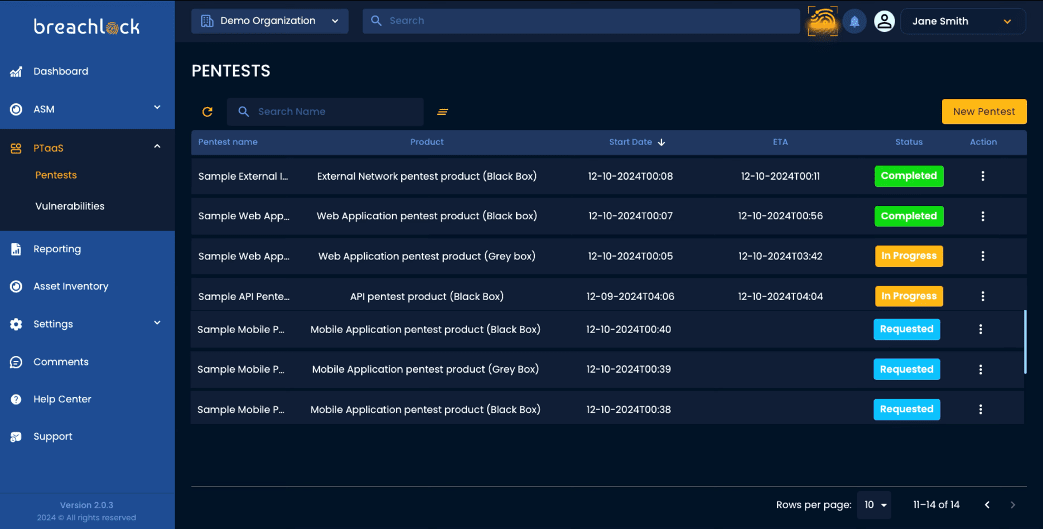
BreachLock is one of the most recognizable names in mid-market web app penetration testing providers, built around a “human-led, AI-accelerated” model delivered through a single portal. You can scope a CREST-certified test and kick off in a day or two, watch findings appear in real time, and pull audit-ready reports mapped to the usual frameworks.
It is a strong fit if you want a SaaS-like experience and predictable, packaged pricing rather than a bespoke consulting engagement.
- Best at: Fast, packaged, platform-delivered pentests for teams that test more than once a year.
- Services offered: VAPT manual depth (✓), authenticated testing (✓), PTaaS/continuous (✓), API testing (✓), business logic (✓), compliance/attestation (✓), source review (✗), remediation and retesting (✓, unlimited automated retests).
- Testing style: PTaaS platform, human-led with heavy automation.
- Stack coverage: Classic web, SPA, API, mobile; network, cloud, and IoT available.
- Best-fit buyer: Mid-market and SMB teams that want speed, a portal, and compliance-ready reports without a consulting-style scope.
- Watch for: Automation does a lot of the first pass, so for a deep adversary-style engagement, confirm how many manual hours your tier actually includes. Some reviewers flag pricing creep at higher tiers and slow handling of false-positive disputes.
Software Secured
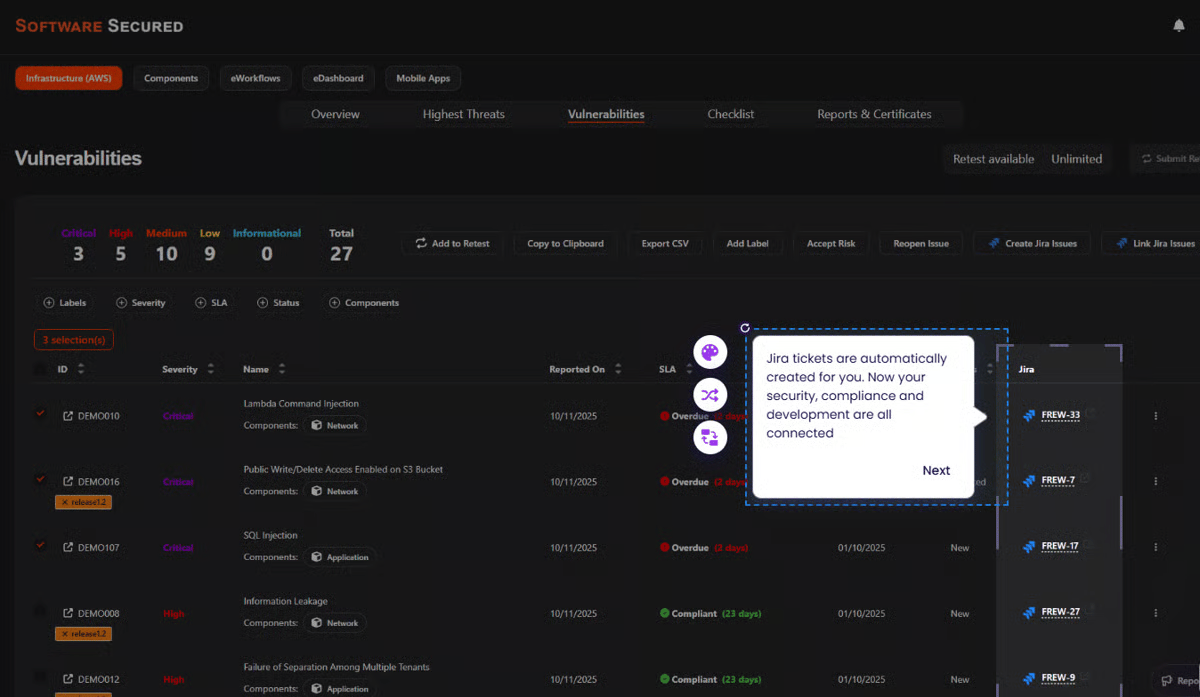
A Canadian boutique that has focused on SaaS since 2010 and runs a full-time, manual-first team rather than a scanner with a report attached. Their PTaaS offers scheduled multiple tests around your releases, includes unlimited retesting within the window, and gives you direct Slack access to the testers. Reports map cleanly to SOC 2 controls with reproduction steps developers actually trust.
- Best at: Manual-led pentesting for SaaS companies that want depth and a real human relationship.
- Services offered: VAPT manual depth (✓), authenticated testing (✓), PTaaS/continuous (✓), API testing (✓), business logic (✓, including BOLA and OAuth/SAML/JWT flows), compliance/attestation (✓), source review (✓, secure code review), remediation and retesting (✓, unlimited within the engagement window).
- Testing style: Manual-led, with a platform/portal for findings and PTaaS scheduling.
- Stack coverage: Classic web, SPA, API, mobile; external network and internal cloud services.
- Best-fit buyer: SaaS teams that want hands-on manual testing, code review, and transparent published pricing.
- Watch for: It is a focused boutique, so capacity and scheduling can be tighter than a large platform’s, and the team is Canada-based, which is worth noting if time zone or data-residency expectations matter to you.
NetSPI
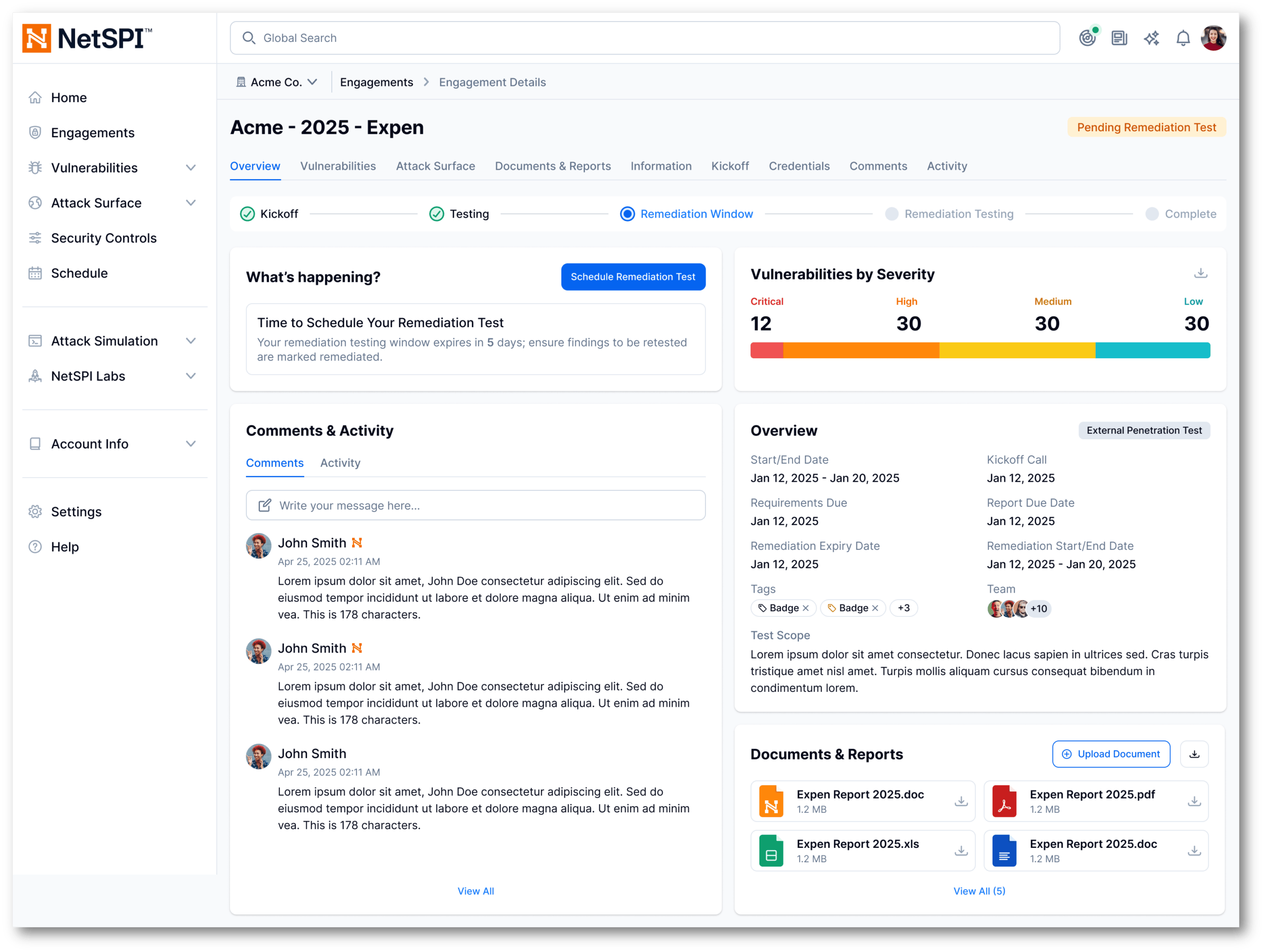
NetSPI started with the PTaaS category and now runs it at the enterprise level with 350+ in-house testers, a mature platform, and a catalog spanning more than 50 test types. It covers web, API, network, cloud, mainframe, hardware, and red teaming under a single program, with the dashboards and integrations a large security team expects.
- Best at: Enterprise-grade managed pentest programs with deep manual testing and very broad coverage.
- Services offered: VAPT manual depth (✓), authenticated testing (✓), PTaaS/continuous (✓), API testing (✓), business logic (✓), compliance/attestation (✓, PCI/SOC 2/HIPAA), source review (✓, secure code review with SAST), remediation and retesting (✓, with platform access for a year).
- Testing style: PTaaS platform backed by a large in-house consulting team.
- Stack coverage: Classic web, SPA, API, mobile; plus network, cloud, hardware, mainframe, and AI/ML.
- Best-fit buyer: Mid-market to large enterprises, especially regulated industries that want named in-house testers and program-level coverage.
- Watch for: Built for enterprise budgets and scope. For a single small web app or a first SOC 2 test, it is likely more program (and cost) than you need.
Bishop Fox
Bishop Fox is generally known for its elite offensive security and red teaming, with 20 years of adversary tradecraft and a client list heavy on the Fortune 100. Their Cosmos platform runs application testing with an internal AI engine that accelerates discovery, but every meaningful finding is still validated by a human, and they emphasize authenticated, attack-path-driven testing over isolated bug lists.
- Best at: Deep, attacker-realistic offensive testing and red teaming for complex, high-stakes environments.
- Services offered: VAPT manual depth (✓, elite), authenticated testing (✓), PTaaS/continuous (✓, via Cosmos), API testing (✓), business logic (✓, chained attack paths), compliance/attestation (✓), source review (✓), remediation and retesting (✓, unlimited remediation testing in Cosmos).
- Testing style: Manual-led, AI-assisted, platform-delivered.
- Stack coverage: Classic web, SPA, API, thick client, e-commerce, mobile; plus cloud, hardware, and red team.
- Best-fit buyer: Enterprises and security-mature organizations that want top-tier offensive depth and portfolio-wide coverage.
- Watch for: Premium positioning aimed at large, complex portfolios. If you are a small team that needs a straightforward compliance pentest, this is more firepower than the job calls for.
HackerOne
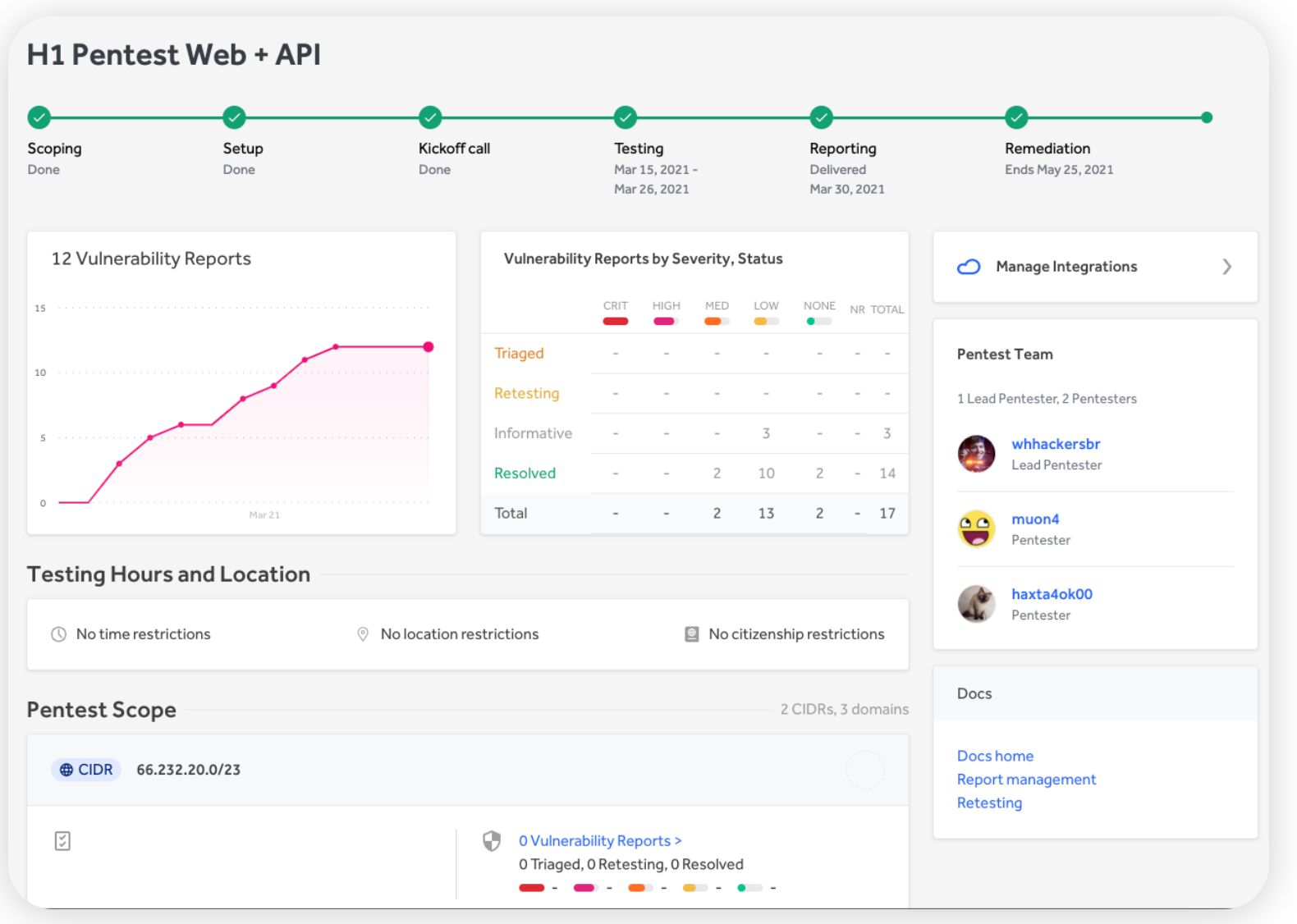
Best known for bug bounty, HackerOne also runs a structured pentest offering (HackerOne Pentest) that taps its vetted researcher community and delivers through a familiar platform, often layered on top of an existing bounty program. You get diverse perspectives and broad coverage across web, API, mobile, cloud, and AI, with compliance-ready reporting for the major frameworks.
- Best at: Crowdsourced discovery plus structured pentests on one platform, for teams that want both.
- Services offered: VAPT manual depth (✓, researcher-led), authenticated testing (✓), PTaaS/continuous (✓), API testing (✓), business logic (✓), compliance/attestation (✓), source review (upsell/scoped), remediation and retesting (✓, researcher-dependent turnaround).
- Testing style: Crowdsourced researchers plus an AI-assisted platform.
- Stack coverage: Classic web, SPA, API, mobile, cloud, AI/LLM.
- Best-fit buyer: Security-mature teams that already run, or want to add, a bug bounty alongside formal pentests.
- Watch for: Quality and turnaround can vary with researcher availability, and users report triage can be slow and the platform has a learning curve. It shines most for teams with the maturity to manage a crowd.
Synack
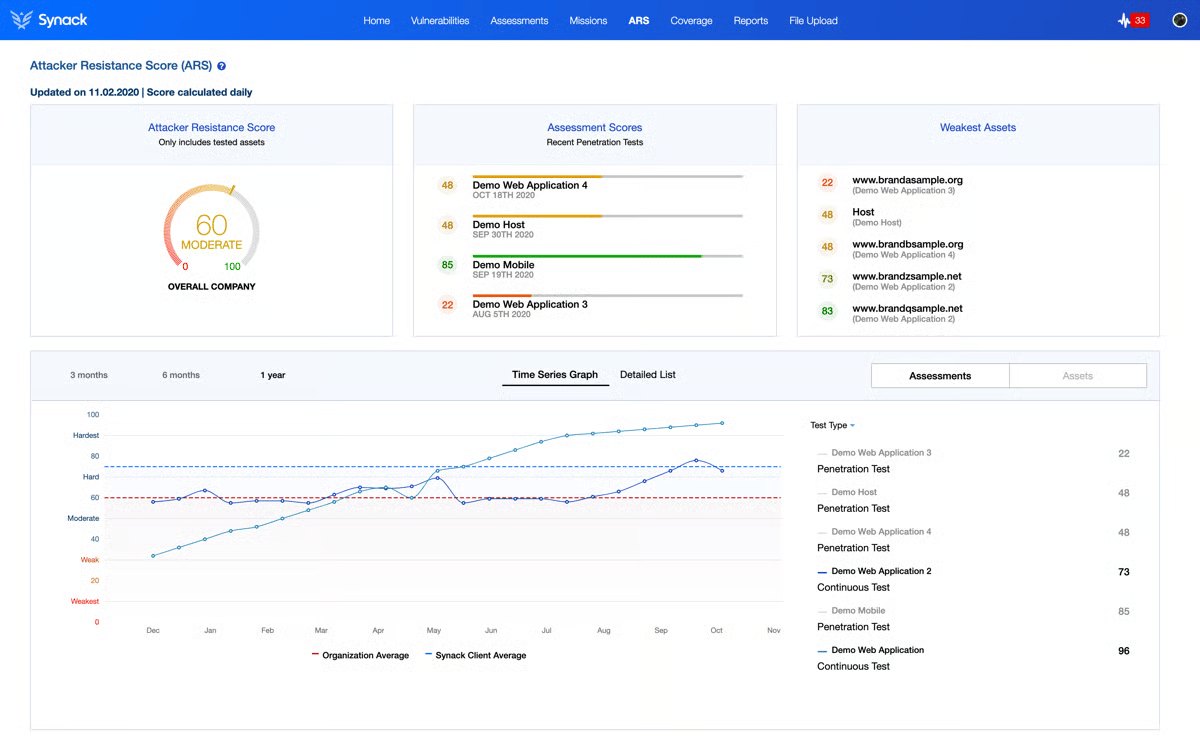
Synack delivers crowdsourced testing via their Synack Red Team, a community vetted far more strictly than an open bounty, inside a controlled platform with an AI agent (SARA) handling reconnaissance and continuous coverage. Its FedRAMP authorization and strong identity vetting make it a natural fit for government and highly regulated enterprises that want crowd diversity without an open program.
- Best at: Vetted, controlled crowdsourced testing for sensitive and regulated environments.
- Services offered: VAPT manual depth (✓, vetted crowd), authenticated testing (✓), PTaaS/continuous (✓), API testing (✓), business logic (✓, multi-step and evasion-heavy), compliance/attestation (✓), source review (✗), remediation and retesting (✓, researcher-based).
- Testing style: Vetted crowdsourced platform with AI-assisted reconnaissance.
- Stack coverage: Classic web, SPA, API, mobile; cloud and AI/LLM.
- Best-fit buyer: Government agencies and enterprises with sensitive assets that want crowd coverage with strict vetting and federal-grade controls.
- Watch for: Pricing and procurement are oriented to enterprise, and like any crowd model, throughput depends on researcher engagement. Likely overkill for an early-stage startup.
NCC Group
A large, research-driven consultancy headquartered in the UK with deep accreditations (CREST, CHECK, CBEST, PCI QSA) and 16 service lines, including source code review, assumed-breach, purple teaming, and ICS/SCADA. If your procurement requires CREST or you operate in a heavily regulated sector, NCC Group is built for that world, with the rigor and attestation strength to match.
- Best at: Accreditation-heavy, consultant-led testing for regulated enterprises and complex environments.
- Services offered: VAPT manual depth (✓, deep), authenticated testing (✓), PTaaS/continuous (limited, consultancy model), API testing (✓), business logic (✓), compliance/attestation (✓, strong, CREST/CHECK/PCI QSA), source review (✓), remediation and retesting (typically scoped/billed separately).
- Testing style: Manual-led, project-based consulting.
- Stack coverage: Classic web, SPA, API, mobile; plus network, cloud, source code, IoT, and ICS/SCADA.
- Best-fit buyer: Regulated enterprises that need recognized accreditations and a single consultancy across many testing types.
- Watch for: This is traditional consulting, not a self-serve PTaaS platform, so expect longer procurement, scheduled engagements, and enterprise pricing rather than a real-time dashboard.
Rhino Security Labs
A boutique offensive shop known for deep technical chops and custom, expert-led engagements, with a particular reputation in cloud and AWS testing. There is no big crowdsourced platform here; the value is senior testers building a tailored engagement and writing high-quality reports for complex or unusual environments.
- Best at: Boutique, expert-led testing for technical teams with complex or cloud-heavy environments.
- Services offered: VAPT manual depth (✓), authenticated testing (✓), PTaaS/continuous (✗), API testing (✓), business logic (✓), compliance/attestation (✓), source review (✓, white-box available), remediation and retesting (scoped, confirm inclusion).
- Testing style: Manual-led, point-in-time consulting.
- Stack coverage: Classic web, SPA, API; strong on cloud and AWS, plus network and mobile.
- Best-fit buyer: Technically sophisticated teams that want a senior, tailored engagement rather than a platform subscription.
- Watch for: As a boutique, scheduling and capacity can be constraints, and the point-in-time model means it is not the right pick if your real need is continuous, release-by-release coverage.

Services-to-Provider Matrix
One grid, all nine providers, scored against the services that decide most engagements. This is the fastest way to see who leads on the thing you actually need.
Legend: ✓ included as standard, $ upsell or add-on, ✗ not offered (or not a core offering).
| Provider | VAPT manual depth | API testing | PTaaS / continuous | Business logic | Compliance / attestation | Source review | Retest included |
|---|---|---|---|---|---|---|---|
| BreachLock | ✓ | ✓ | ✓ | ✓ | ✓ | ✗ | ✓ |
| Astra Security | ✓ | ✓ | ✓ | ✓ | ✓ | $ | ✓ |
| Software Secured | ✓ | ✓ | ✓ | ✓ | ✓ | ✓ | ✓ |
| NetSPI | ✓ | ✓ | ✓ | ✓ | ✓ | ✓ | ✓ |
| Bishop Fox | ✓ | ✓ | ✓ | ✓ | ✓ | ✓ | ✓ |
| HackerOne | ✓ | ✓ | ✓ | ✓ | ✓ | $ | ✓ |
| Synack | ✓ | ✓ | ✓ | ✓ | ✓ | ✗ | ✓ |
| NCC Group | ✓ | ✓ | ✗ | ✓ | ✓ | ✓ | $ |
| Rhino Security Labs | ✓ | ✓ | ✗ | ✓ | ✓ | ✓ | $ |
A few honest notes on reading this grid:
- A ✓ in “VAPT manual depth” means manual testing is genuinely part of the standard engagement, not that every provider tests to the same depth. A boutique like Rhino or an offensive shop like Bishop Fox will generally go deeper per app than a high-automation platform.
- “Retest included” hides a real distinction. Platform vendors often include automated rescans, while crowdsourced models rely on researchers to re-verify, which can vary in turnaround. For compliance, confirm the retest produces evidence your auditor will accept, not just a clean scan.
- “PTaaS / continuous” marks whether continuous, platform-delivered testing is a core model, not whether the vendor can be retained repeatedly. A consultancy can test you every quarter; that is still a series of point-in-time engagements.
How to Match Services You Need to the Right Provider
Skip the vanity rankings. Start from your situation, find the service it actually requires, then prioritize web app penetration testing providers that offer that service as a ✓, not a $.
- Your first pentest, or a tight compliance deadline: You need authenticated, manual web and API testing with a clean attestation and retesting included. Prioritize providers that bundle compliance reporting and retests as standard: Astra, BreachLock, and Software Secured are built for exactly this, and NetSPI fits if you are larger and want named in-house testers.
- You ship features weekly: Point-in-time testing will always lag your releases, so you want PTaaS with CI/CD integration. Look at Astra, BreachLock, Software Secured, and NetSPI, and rule out the point-in-time-only consultancies for this job.
- API-heavy product (REST, GraphQL, SSO, tokens): Make API testing an explicit ✓ in your scope, not an assumption. Every provider here tests APIs, but confirms GraphQL and auth-token handling are in the statement of work rather than a separate line item.
- Deep business-logic risk or a complex/cloud-heavy environment: This is manual territory. Favor manual-led depth: Astra Security, Rhino Security Labs, NCC Group, and Software Secured. A high-automation platform can find the obvious flaws faster, but chained logic abuse needs senior human time.
- Strict procurement (CREST/CHECK) or sensitive/regulated data: Accreditation and vetting lead the decision. NCC Group for CREST/CHECK-driven procurement; Synack for a vetted crowd in sensitive or federal environments.
- You want offensive depth or a red team, not a checklist: Bishop Fox for adversary-realistic testing, with NCC Group and Rhino as strong alternatives.
Where does that leave a growth-stage SaaS team that needs SOC 2 or ISO evidence, ships often, and does not have an enterprise budget? That is the exact column where our ✓ marks line up: manual-plus-automated testing, continuous PTaaS, API coverage, business-logic testing, a verifiable certificate, and retesting, in one dashboard. And that is where Astra shines best. Book your demo now.
FAQs
Is authenticated testing worth the extra cost?
In almost every case, yes. Most of a web app’s real risk lives behind the login: broken access control, privilege escalation, and data exposure between accounts. Unauthenticated testing only sees your front door. If budget forces a choice, authenticated grey-box testing usually gives you far more signal per dollar.
Does a web pentest cover my APIs, or is that separate?
Do not assume. Many providers scope (and price) API testing separately from the web front end, especially for GraphQL or token-based auth. Ask for APIs to be named explicitly in the statement of work, and confirm whether each distinct API counts as additional scope.
Is retesting included after we fix the issues?
Sometimes included, sometimes capped, sometimes billed separately, so always check. Platform providers often include automated rescans, and some include a set number of manual retests. For compliance, the important question is whether the retest produces evidence of a verified fix that your auditor will accept, not just a clean rescan.
Which service do I need for SOC 2 or PCI compliance?
For SOC 2, you need a manual penetration test (not just a scan) with a report mapped to the Trust Services Criteria, documented remediation, and retest evidence, plus an attestation letter or certificate.
For PCI DSS, you need internal and external penetration testing at least annually and after significant changes. In both cases, prioritize a provider that delivers attestation and retesting as standard rather than as add-ons.
How much does a web app pentest cost?
As a rough 2026 planning range: a small web app pentest commonly runs about $5,000 to $15,000, a SOC 2-scoped SaaS engagement (web app plus API plus cloud) about $8,000 to $25,000, and continuous PTaaS subscriptions roughly $20,000 to $120,000 per year for larger scopes. Astra offers dedicated account manager, manual pentest, API & AI systems check and compliance ready reporting at just $6000 per year. Check full pricing here.