Every modern engineering team pushes code multiple times a day. With each deployment, the attack surface shifts and expands in real time as new dependencies and configurations emerge.
According to recent industry data, 16% of teams now deploy on demand or multiple times a day. At this pace, securing the attack surface with traditional pentesting is like playing an exhausting game of Whack-a-Mole, while here the targets never stop evolving and multiplying.
At the same time, many state-sponsored threat actors have aggressively embraced agentic AI for offensive operations, creating a dangerous asymmetry where attackers operate with autonomous speed and scale, while defenders still rely on slow, human-dependent security processes.
The only viable response is the rapid adoption of Agentic AI in cybersecurity.
What is Agentic AI in Cybersecurity
Agentic AI in cybersecurity refers to autonomous, adaptive AI systems that emulate human hackers by making intelligent context-aware decisions, seamlessly orchestrating multiple tools, and executing complex multi-step defensive and offensive workflows with minimal human input.
In contrast to traditional AI/ML security tools that classify, score, or flag inputs for human review, agentic AI in cybersecurity can:
- Ingest and reason over multiple data streams simultaneously (logs, network traffic, threat intel feeds, endpoint telemetry)
- Execute multi-step response plans.
- Iterate and self-correct when an action doesn’t produce the expected outcome
- Operate continuously, without fatigue or cognitive overload.
Why Cybersecurity Needs Agentic AI Security
In AOW, Sun Tzu said, “Know the enemy and know yourself, and you need not fear the result of a hundred battles.” The security industry knows the enemy very well, but struggles to close the security gaps in its own defenses.
GTIG confirms that the underground marketplace for AI-powered offensive tooling has matured, and many State-sponsored actors and cybercriminals are already using it. The defensive side, by contrast, is still deliberating, as most security teams continue to rely on manual pentesting and triaging.
Threat actors have begun using early versions of these tools, and it is only a matter of time before more powerful agentic AI capabilities are widely democratized among them.
This mirrors the way threat actors used Cobalt Strike in the 2020s. Cobalt Strike was introduced to the market as a professional red team tool. Once cracked versions flooded the underground market, it was rapidly abused by ransomware gangs and criminals, dramatically lowering the skill barrier and scaling attacks across the industry.
Agentic AI security tools are on the exact same path, and the impact will be far greater here. These agentic AI security systems can autonomously plan, adapt, chain exploits, and operate at machine speed, turning even low-skilled threat actors into highly effective threats.
A GTIG study shows the average time-to-exploit fell from 63 days in 2018 to negative 7 days by 2026. In this threat environment, even if an attack surface were free of vulnerabilities, defending against threats at this speed is extremely difficult.
Only with proper offensive and defensive agentic AI security tools security teams have a fair chance against these threats.
How Agentic AI Works in Cybersecurity?
Understanding how AI agents in security function helps teams evaluate, deploy, and govern them effectively. The architecture typically consists of several cooperating components
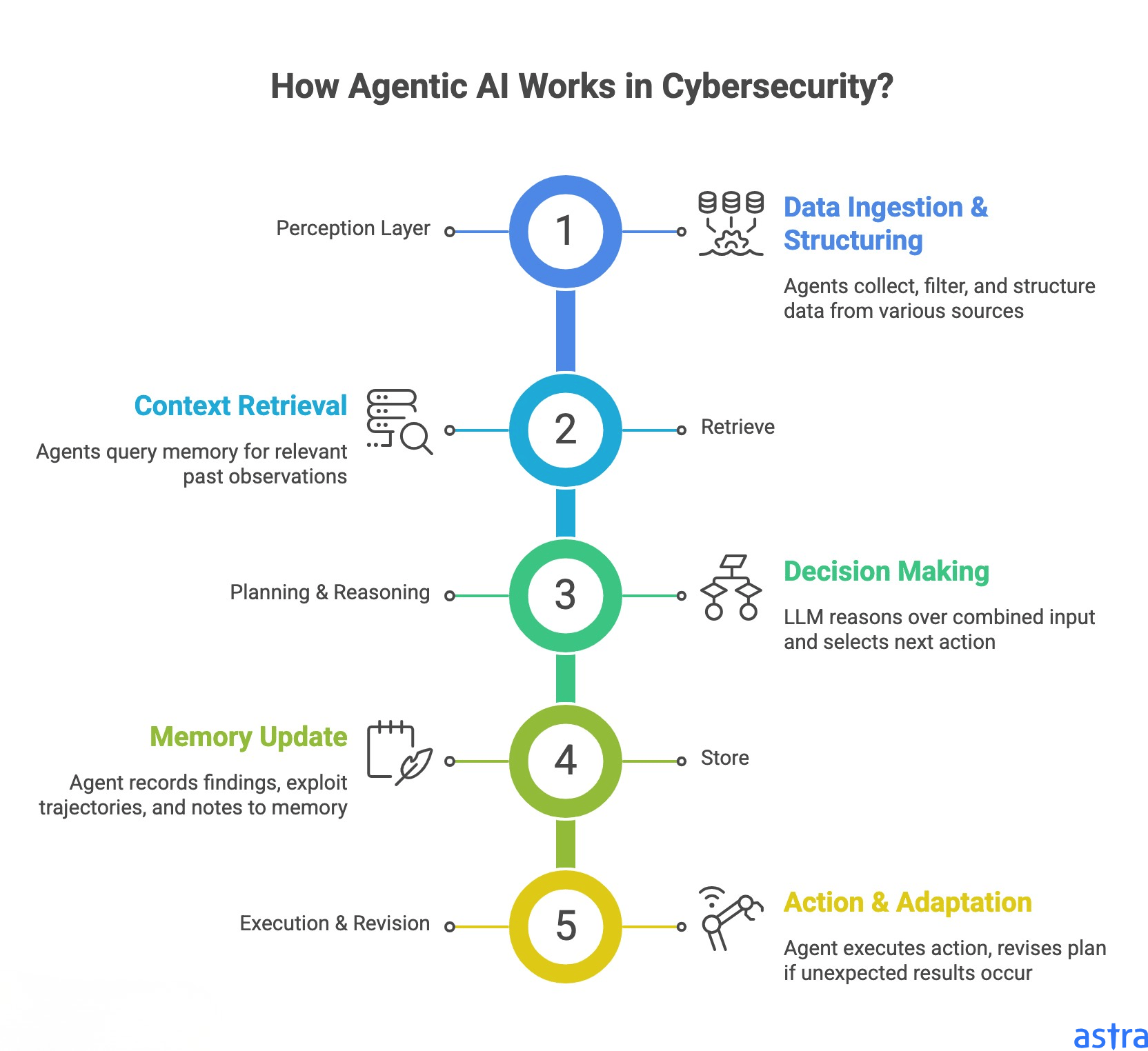
Perception Layer (Data Ingestion)
Agents ingest structured and unstructured data from various data sources and sensors, e.g., threat intelligence feeds, SIEMs, EDR platforms, etc. When data enters the perception layer, it is filtered, summarized, and turned into structured observations that the LLM can reliably reason over.
In practice, that step depends heavily on ai data mapping, because telemetry from security tools rarely arrives in identical formats or field structures. Consistent reasoning gets harder when the agent is forced to interpret mismatched source data at ingestion time.
Context Retrieval
The AI agents query their memory layer using similarity search or other methods to retrieve relevant context from what they just observed earlier, e.g., prior findings, recurring patterns, etc.
Planning and Reasoning
In this phase, LLMs reason over the combined input using data from both the perception layer and retrieved memory. Based on that, LLM selects the next COA and produces a structured output for the orchestration layer to execute. Chain-of-thought prompting makes this reasoning step explicit and auditable.
This planning phase is what separates agentic AI from the automation script. The agent can revise its plan mid-execution if new evidence changes the picture.
Memory Update
After execution, the agent writes new findings, successful and failed exploit trajectories, updated attack path state, and reflective notes to memory that influence future decisions within the same engagement or across subsequent ones.
Adoption
This loop runs continuously, with each iteration updating the agent’s internal model of the target environment. When an action produces an unexpected result, the agent revises its plan rather than halting. That adaptive re-planning is what separates agentic systems from rule-based automation.
What are the use cases of Agentic AI in Cybersecurity?
The breadth of autonomous AI cybersecurity applications is expanding rapidly. Below are the most impactful use cases observed in production deployments today.
Autonomous Penetration Testing
One of the most technically sophisticated applications of agentic AI in cybersecurity is autonomous penetration testing. Traditional penetration testing is typically a point-in-time engagement, conducted quarterly or annually, limited by the scope of the pentester’s bandwidth. Autonomous AI cybersecurity fundamentally changes this model.
An autonomous penetration testing tool can:
- Continuously enumerate attack surfaces across web apps, APIs, and other systems.
- Chain vulnerabilities to simulate realistic multi-stage attack paths.
- Distinguish theoretical vulnerabilities from ones that can actually be leveraged.
- Re-test automatically after patches are applied to verify the fix.
Vulnerability Remediation and Code Patching
Some advanced agentic platforms in the market can close the loop entirely: after identifying a vulnerability, they can generate a non-breaking code fix using Code Property Graph analysis, notify the changes, update the relevant development team via Jira or GitHub, and validate that the fix resolves the vulnerability in the next test cycle.
Threat Hunting
Proactive threat hunting, i.e., searching for adversary activity that hasn’t triggered alerts. It is one of the highest-value and most resource-intensive security activities.
Agentic AI accelerates it significantly by :
- Hypothesis creation based on threat intelligence feeds and TTPs from MITRE ATT&CK.
- Automated query generation and execution across SIEM and EDR platforms.
- Pattern correlation across millions of events to detect an anomaly.
- Continuous operation across various time zones.
Autonomous Threat Detection and Incident Response
Agentic systems can autonomously detect, investigate, and respond to security incidents end-to-end. When an anomalous login triggers an alert, instead of queuing for human review, the agent:
- Queries authentication logs across all related systems
- Cross-references the IP against threat intelligence databases
- Checks whether the account has MFA enabled and whether the device is managed
- Reviews recent activity for the user account
Securing Agentic AI Systems
Integrating conventional applications into existing workflows or systems doesn’t bring significant changes, and their attack surface is enumerable and almost static. Agentic AI security breaks every one of these assumptions. Securing it requires a fundamentally different control model, one built around the assumption that the agent itself is an untrusted component operating inside a governed boundary.
Some tips for hardening your system before deploying agentic AI security tools.
Foundation Model Governance as a Security Control
The agentic AI security brain, i.e., LLMS, is not a static dependency. Its capability profile changes with every version update, fine-tune, adapter change, or provider migration. A model version should be treated as a security event, and behaviors validated under a prior model version cannot be assumed to hold in the new version, e.g., with respect to scope enforcement accuracy or manipulation resistance.
Poisoning of Memory Layer
Threat actors can poison the memory layer to hinder the agent’s ability to get context from past actions. During the retrieve stage, the agentic AI loop draws on vector stores and knowledge graphs to retrieve context. If those ector stores are compromised prior to engagement through a supply chain attack or cross-engagement contamination, the agent will lose its decision-making ability over time.
Agent Drift
An agent calibrated against the threats 30 days before may not work well as cybersecurity evolves every day. This is mostly due to the vector store accumulating new trajectories over time, which produces reasoning outputs that were never explicitly validated. Performance monitoring must be instrumented at each stage of the perceive-retrieve-reason-store loop independently to avoid agent drift.
Red-Team Your Agents
Any agent operating in a security-critical context must itself be treated as a security-critical system. Before expanding an agent’s autonomy tier or scope, conduct structured adversarial testing specifically designed for agentic systems. Treat your AI agents like any other security-critical system, and they need penetration testing too.
Agentic AI vs. Generative AI vs. AI Agents
Confusion between these three terms is rampant in the industry. For agentic AI security operations teams evaluating vendors and platforms, a precise understanding matters.
| Aspect | Gen AI | AI agents | Agentic AI |
|---|---|---|---|
| Core function | Content creation from prompts | Autonomous task execution | Autonomous, goal-directed operations |
| Memory | Stateless (per session) | Limited, task-scoped | Persistent, long-horizon memory |
| Decision-making | Reactive to prompts | Rule-based or single-loop | Dynamic, iterative planning loops |
| Tool use | Limited or none | Predefined tools | Dynamic tool orchestration |
| Adaptability | Static responses | Limited adaptation | Continuously learns and adapts |
| Example | ChatGPT, Claude (LLMs) | Basic SOAR playbooks | Astra security’s autonomous pentesting tool |
The relationship is hierarchical: Generative AI is the brain providing language-based reasoning. AI agents are the hands that execute specific tasks. Agentic AI is the full system a body that combines brain, hands, memory, and strategic thinking to pursue complex goals autonomously over extended time horizons.
Challenges of Agentic AI
Deploying agentic AI at a large scale in cybersecurity introduces distinct risks that security teams must account for. The same autonomy that makes these systems powerful also introduces new attack surfaces and failure modes.
Misaligned Action
An AI agent with authorization to isolate endpoints, block IPs, or modify firewall rules could disrupt prod if it acts on a false positive or on poorly defined ROE. The blast radius of an autonomous security action is far greater than an incorrect alert.
So devs behind the tool should define:
- In which scenarios should agents ask for human authorization before taking action?
- Prefer reversible actions (quarantine over deletion, block over null-route).
- Caps on how many autonomous actions can be taken within a time window.
Hallucinations
Sometimes, using agentic AI in cybersecurity can generate incorrect assessments that sound true. For example, an autonomous pentesting tool attempting to exploit paths that don’t actually exist causes unintended side effects in an attempt to exploit.
Prompt Injection
Prompt injection is the most exploited vulnerability in LLM applications, according to OWASP. Attackers embed malicious instructions inside files, emails, or web pages that the agent processes, redirecting its actions. For example, an agentic pentesting tool scanning a target application could be manipulated by instructions hidden in the application’s response bodies.
Audit Trail Integrity
An agentic system’s audit trail is only meaningful if the agent cannot modify it. A compromised agent that has write access to its own operational logs can reconstruct a false history, selectively delete evidence of out-of-scope actions, or alter confidence scores on suppressed findings.
Implementation Guide: How to Adopt Agentic AI in Cybersecurity
Successful adoption requires a structured approach, and deployment should not be driven by vendor hype. Here is a practical roadmap:
1. Audit Your Data Foundation
Agentic AI is only as good as the data it can access. Consolidate or federate your security data from various sources, e.g., SIEM logs, EDR telemetry, into queryable, reliable sources before introducing autonomous agents.
2. Have Autonomy Tiers
Segment every security action your organization performs into three explicit autonomy tiers before any agent touches a production system.
- Fully autonomous – agents act without human involvement (e.g, enrichment, correlation).
- Human-assisted – When the agent produces a verdict or action (e.g., incident classification).
- Human-required – Circumstances where the agent can’t act without explicit authorization (e.g, isolating endpoints, account lockout).
These tiers must be documented in a formal autonomy matrix and tested thoroughly before deployment.
3. Start with Alert Triage
Alert triage is the correct first deployment target for agentic AI in security operations for three reasons,
- Volume is high.
- Scope is well-defined.
- The blast radius of an incorrect decision is comparatively contained.
Once agents demonstrate accuracy here, expand their scope gradually.
4. Establish Governance
Agent objectives, tool access scopes, memory-isolation boundaries, audit-logging requirements, escalation paths, and responsible ownership must all be defined and documented before any agent goes live. Designating a responsible owner for each agent deployment makes it easy to track and improve AI agent performance over time.
5. Integrate Human Oversight Workflows
Human oversight is not a fallback mechanism. It is a designed component of the agentic architecture. Analysts must be able to inspect a decision at any point in the perceive-retrieve-reason-store loop, override the agent’s verdict, inject corrective context back into memory, and trigger an immediate halt without complex procedures.
6. Track Everything
Track accuracy rates, false positive and false negative rates, MTR, analyst override frequency, and analyst time saved across every workflow the agent touches.
For example, excessive override by analysts indicates either reasoning drift, data quality degradation, or a mismatch between the agent’s retrieved context and the current threat environment.
Future of Agentic AI in Cybersecurity
The trajectory of agentic AI in security points toward systems that are significantly more capable, collaborative, and embedded in security operations than what exists today.
Self-Healing Infrastructure
Agentic AI in the upcoming years will be able to detect and automatically patch vulnerabilities, reconfigure security controls, and rebuild compromised infrastructure, with minimal human intervention.
Adversarial AI Arms Race
As defensive agentic AI matures, adversarial use of AI will escalate correspondingly. Attackers are already using AI to generate polymorphic malware, craft hyper-personalized phishing campaigns, and automate reconnaissance. The security industry should expect an AI-versus-AI dynamic to become a defining feature of the threat landscape by 2027.
Regulatory exposure
Regulatory frameworks like the EU AI Act are starting to address AI in the cybersecurity domain. Security teams deploying agentic AI in regulated environments should expect compliance obligations to expand significantly over the next two to three years
As a pioneer of the APTS framework (a methodology similar to PTES and OWASP WSTG tailored for autonomous penetration testing tools), Astra Security possesses in-depth expertise in navigating regulatory requirements for agentic AI in offensive security testing. We pay particular attention to critical areas such as human oversight, auditability, and safety controls.
If you are using our autonomous pentesting tools or any solution designed with APTS in mind, you can be confident that compliance will remain smooth and manageable as regulations tighten. So when evaluating pentesting tools with agentic AI capabilities, look for solutions built on the APTS framework.
Autonomous Pentesting
Autonomous pentesting is expected to become one of the most impactful applications of agentic AI in cybersecurity. Instead of relying solely on periodic manual pentests, security teams can deploy AI agents that continuously identify vulnerabilities across dynamic environments.
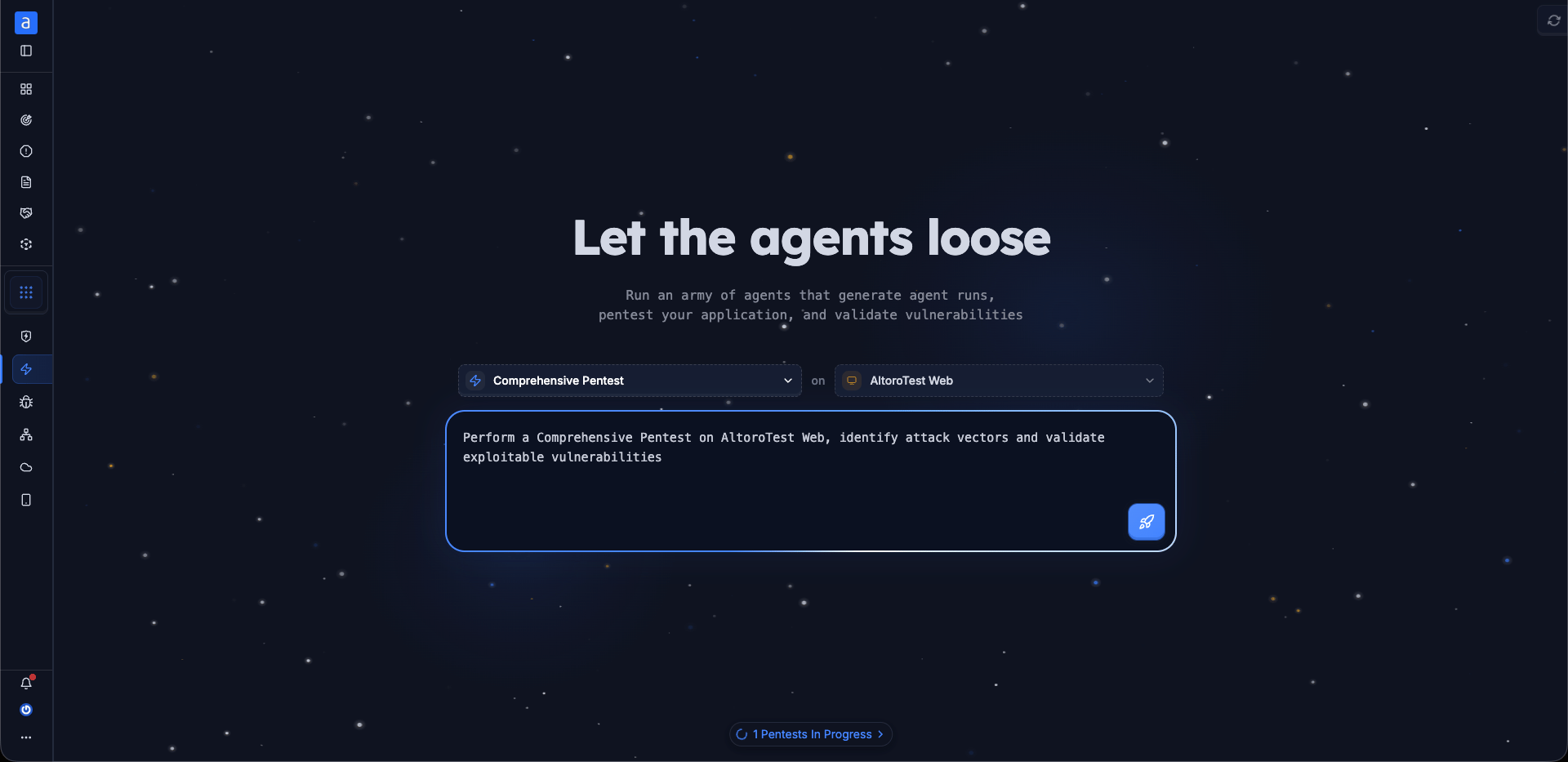
At Astra Security, we are already moving in this direction by introducing an autonomous pentesting tool that operates with minimal human intervention. Built on insights from 5000+ real-world pentests, it delivers up to 80x faster pentesting, enabling security teams to dramatically increase pentest cadence cost-effectively.
Final Thoughts
The debate about whether agentic AI belongs in cybersecurity is over. Agentic AI is already there, on both sides of the line. The question that remains is whether the organizations deploying it on the defensive side are doing so with the governance discipline that the technology demands.
The threat environment has made the case for autonomous security capability better than any vendor could. The volume, speed, and reasoning capability of the offensive threat have crossed a threshold that reactive, manual-first security operations cannot match at scale.
FAQ
1. What is agentic AI in cybersecurity?
Agentic AI in cybersecurity refers to autonomous systems that combine an LLM reasoning core with persistent memory, tool orchestration, and a continuous perceive-retrieve-reason-store loop to handle complex security-related tasks(both offensive and defensive) with minimal human input.
2. How is agentic AI different from generative AI?
Generative AI produces outputs in response to discrete prompts and maintains no state between interactions. Agentic AI uses an LLM as its reasoning engine to execute long-horizon workflows across complex, multi-stage security operations with minimal human intervention.
3. Can agentic AI replace cybersecurity analysts?
No, agentic AI cannot replace cybersecurity analysts from the loop. Human analysts remain essential for high-stakes decisions(e.g, Agents isolating DBs, revoking access), novel threat scenarios outside the agent’s training distribution, adversarial edge cases, ethical judgements, and stakeholder communication.
4. What are examples of agentic AI in security operations?
Examples include autonomous penetration testing agents, advanced SOAR platforms, and SOC triage agents that enrich, investigate, and verify alerts at machine speed while continuously adapting to evolving threats and executing multi-step response playbooks with minimal human involvement.
5. What are the risks of using agentic AI in cybersecurity?
The primary risks are prompt injection attacks that override agent instructions mid-execution and memory-layer poisoning that gradually degrades the agent’s reasoning quality over time. Proper safety procedures and regular auditing can mitigate these types of risks.
6. How does agentic AI improve threat detection?
Agentic AI significantly improves threat detection. It enables real-time multi-source data correlation, proactive anomaly hunting, adaptive learning from new attack patterns, and autonomous hypothesis testing, allowing faster and more accurate identification of sophisticated threats than traditional tools.