
Key Takeaways
- What It Is: A continuous process to identify and manage internet-facing assets that could expose the organization to external threats.
- Why It Matters: Google’s scale and velocity create blind spots that attackers can see long before internal teams do.
- Core Capabilities: Automated discovery, real-time monitoring, risk-based prioritization, and guided remediation.
- Key Benefits: Reduces unknown exposures, speeds up response, and supports ongoing compliance.
- Strategic Value: Transforms external risk management into a continuous, integrated security discipline.
If you’re part of a cloud-first organization, building in fintech, healthcare, SaaS, or any environment where infrastructure shifts fast and data matters, external risk isn’t theoretical; it’s operational, with breach patterns evolving and compliance expectations tightening, visibility into what you’ve exposed online is no longer optional.
This article explains what External Attack Surface Management (EASM) really is, why legacy tools are insufficient, and how forward-looking security teams are addressing blind spots before attackers do.
What is External Attack Surface Management?
External Attack Surface Management (EASM) is the continuous process of identifying, monitoring, and managing all internet-facing assets an organization owns (known or unknown) that could be exploited by attackers. Unlike traditional perimeter security, it focuses on blind spots, including forgotten subdomains, misconfigured cloud, exposed APIs, shadow IT, third-party dependencies, and rogue infrastructure.
To understand how EASM fits into the broader security stack, here’s a side-by-side breakdown:
| Category | EASM | Vulnerability Management | Penetration Testing |
|---|---|---|---|
| Scope | External, internet-facing assets (known & unknown) | Known, inventoried assets | Known systems within predefined scope |
| Focus | Discovery, visibility, continuous exposure tracking | Detecting and remediating known vulnerabilities | Simulating real-world attacks to find weaknesses |
| Timing | Continuous, real-time | Periodic (weekly/monthly scans) | Point-in-time |
| Approach | Outside-in, attacker’s perspective | Inventory-based, internal | Manual, adversary emulation |
| Key Value | Uncovers blind spots before attackers do | Supports patch management and compliance | Tests security controls under simulated threat |
Why Does EASM Matter?
For any organization that depends on digital infrastructure such as cloud platforms, SaaS tools, public APIs, global websites, and third-party vendors, the attack surface is no longer just a security problem. It’s a business risk. CISOs, CIOs, and technology leaders are being asked a new question: Do you actually know what your organization has exposed to the internet right now?
The Modern Risk Surface
The traditional network perimeter has dissolved, i.e., infrastructure is now dynamic, spun up and torn down in minutes, developers deploy directly to the cloud, and teams across the business adopt tools and launch digital projects independently. Every one of these actions expands the risk surface.
The problem isn’t just scale but speed and fragmentation as risk is being created faster than it can be inventoried, and much of it is owned outside central IT, leading to incomplete visibility by default.
What’s exposed today may not have existed last week (when the scheduled vulnerability scan ran) and won’t show up in internal systems until it’s already in an attacker’s sights.
The Unmanaged Surface
Within that risk surface is a more dangerous subset: the unmanaged domain: assets that no one owns, no one tracks, and no one secures, but everyone assumes are safe. Simply put, these external assets deliveries exist outside security’s line of sight, but inside the attacker’s kill chain, including:
- Legacy domains that still resolve
- Abandoned test environments accidentally left open
- Cloud assets with default configurations
- Public APIs are no longer in use but still reachable
- Third-party infrastructure tied to your DNS or data
While they may not be high-profile targets, they do qualify as low-hanging fruit: easy to find, exploit, and completely off radar for most security tools. Legacy tools can’t help. Vulnerability scanners and CMDBs don’t catch what they don’t know exists. EDR and firewalls don’t cover what lives outside the network.
If it’s exposed and connected to your brand or your data, attackers will consider it in scope. So should you.

What Makes Astra the Best VAPT Solution?
- We’re the only company that combines automated & manual pentest to create a one-of-a-kind pentest platform.
- The Astra Vulnerability Scanner runs 10,000+ tests to uncover every single vulnerability
- Vetted scans ensure zero false positives.
- Our intelligent vulnerability scanner emulates hacker behavior & evolves with every pentest.
- Astra’s scanner helps you shift left by integrating with your CI/CD.
- Our platform helps you uncover, manage & fix vulnerabilities in one place.
- Trusted by the brands you trust like Agora, Spicejet, Muthoot, Dream11, etc.

How Does EASM Impact Security, Compliance, and Operations?
Security
Security teams make decisions based on known assets, known systems, and known threats. But attackers don’t limit themselves to what’s on your inventory. They scan for what’s public and vulnerable, whether or not it was officially sanctioned.
EASM brings the external environment into focus. It identifies exposures that security tools miss because those tools were never designed to see beyond what was handed to them. That visibility changes how security teams prioritize, investigate, and respond. It aligns internal defense with real-world exposure.
Compliance
Compliance has shifted from box-checking to continuous accountability, where frameworks now assume you can track and prove what is in scope, even as infrastructure moves across teams, regions, and vendors.
EASM strengthens compliance by making the external footprint measurable. It helps document where data might be exposed, where obligations might be overlooked, and where inherited risks from vendors or legacy systems still live. It turns visibility into evidence.
Operations
Operationally, unmanaged assets slow teams down. They cause outages no one sees coming, trigger alerts no one owns, and drain resources during clean-up. They create instability in systems that depend on reliability.
EASM improves operational awareness by surfacing what’s active, what’s exposed, and where ownership sits. It gives operations teams a cleaner foundation to build from and reduces the unknowns that erode uptime and efficiency.
What is the EASM Process?
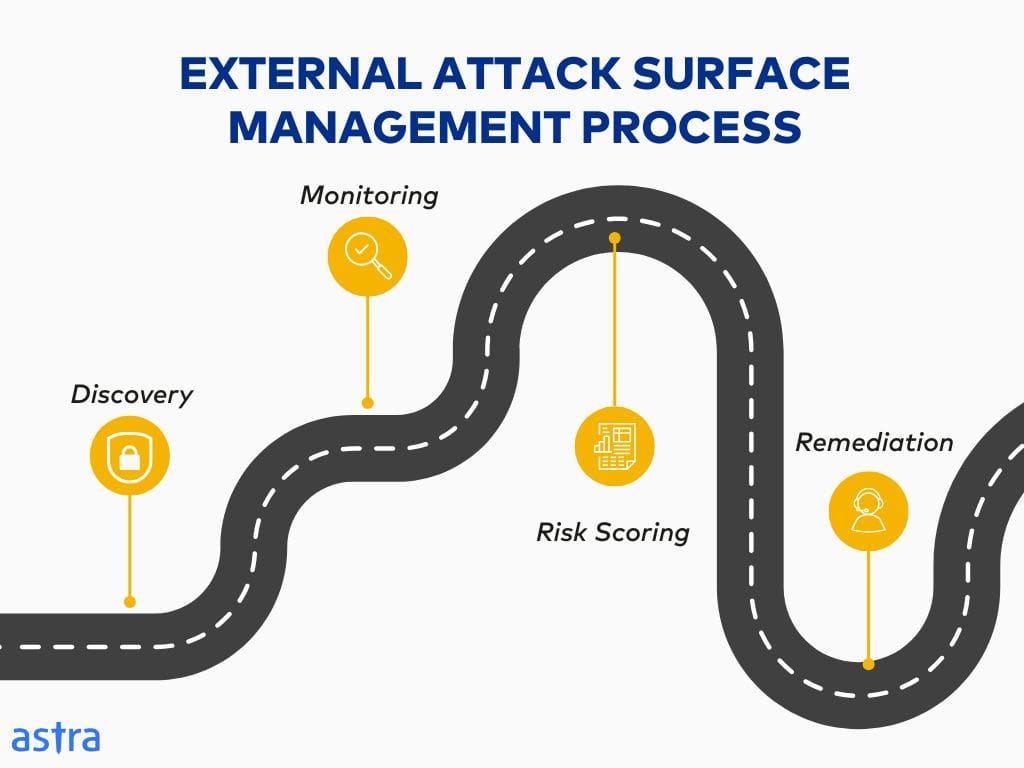
Step 1: Discovery: See Everything Connected to You
Most exposure doesn’t come from core systems but from what’s been spun up at the edges, including test environments, cloud misconfigurations, third-party assets, and shadow IT. These assets don’t always live in CMDBs; they show up in DNS records, TLS certificates, IP ranges, and infrastructure metadata.

Continuous discovery starts by mapping your external exposure from the outside in with no assumptions or reliance on internal lists. EASM uses open-source intelligence, infrastructure fingerprints, certificate data, and attribution logic to surface every internet-facing asset that points back to your organization.
Step 2: Monitoring: Track Changes in Real Time
Exposure isn’t static. Your external footprint changes constantly, not just through major releases, but through small actions like a new code commit, a DNS tweak, or a temporary environment going live.
Modern EASM platforms are built to monitor your attack surface not just on a fixed schedule but in real time. Some tools like Astra can trigger scans automatically whenever a change is detected, even something as lightweight as a deployment to a front-end service or a configuration shift in a cloud environment.

Others let you optimize scanning based on impact. Instead of sweeping everything repeatedly, you can scan only what’s changed, or only what is likely to be affected by a specific push. If needed, full scans are still on the table but the process becomes more intelligent, more targeted, and far less noisy allowing your team to chase security instead of alerts for a change.
Step 3: Risk Scoring : Focus on What Matters
Not every exposed asset is a threat. Risk scoring separates what’s visible from what’s dangerous.
Modern EASM platforms assess technical exposure, such as open ports, known vulnerabilities, or public discoverability, while also layering in business context including asset inventory ownership, function, sensitivity, and alignment with key KPIs. A forgotten dev tool might be low risk, but a misconfigured API tied to customer data or revenue flow is a different story.

Scoring helps teams focus fast. You see not just what’s exposed, but what matters most to your security, operations, and your business.
Pro Tip: Teams on the ground emphasize the growing importance of tying assets to business functions and ownership. As one Reddit user put it, “Tagging assets by business role isn’t just good hygiene… It’s how you stop findings from becoming backlog clutter.” This tagging becomes key to effective scoring and faster resolution.
Step 4: Remediation: Get the Right Fix to the Right Owner
Finding exposure is only half the job. Risk only drops when action is taken by the right people, with the right context.
EASM shifts remediation from isolated ticketing to an integrated handoff, where issues are tied to owners, contextualized with tailored reports, and sent with clear next steps, whether that involves disabling a vulnerable endpoint, reconfiguring a cloud permission, or decommissioning a forgotten asset.

The best systems don’t just flag risk. They close the loop. Teams can confirm fixes, trigger targeted rescans, and display risk reduction in real-time, not just for audits, but also for internal accountability.
Make your SaaS Platform the safest place on the Internet.
With our detailed and specially curated SaaS security checklist.

How to Approach EASM Implementation?
Unlike popular belief, EASM isn’t a plug-and-play feature but a strategic capability that reshapes how your organization sees, prioritizes, and responds to external risk. Implementing it effectively means approaching it with clarity about your footprint, your needs, and your long-term goals.
1. Know Your Digital Footprint
EASM works best when the business accepts that external exposure isn’t just a security problem but the result of decisions made by dev, ops, cloud, product, and third parties. Implementation begins by identifying who’s shaping your digital footprint, not just what’s in it.
The right conversation isn’t “What do we have exposed?”, rather “Who is exposing it, and do they know they own it?”
Before implementing a platform, align stakeholders around the real scope: domains, cloud environments, third-party systems, inherited infrastructure, even digital assets tied to marketing or past M&A activity. The more honest you are upfront, the more value you’ll get from the process.
2. Evaluate EASM Capabilities
EASM becomes powerful when its insights feed into existing workflows of asset management, vulnerability management, cloud governance, and incident response. If it sits in isolation, it creates awareness without action.
Moreover, not all EASM tools operate the same way. Some focus on surface-level scans, while others go deeper with attribution logic, contextual risk scoring, and integration with your broader security workflows.
Look for capabilities that align with your environment:
- Can it distinguish between dev, test, and production?
- Does it identify assets by ownership or business unit?
- Can it trigger scans based on change events?
- Does it connect findings to response workflows such as ticketing, patching, escalation?
3. Choose the Right EASM Tool for You
The best tool for your organization depends on where you’re starting and what you’re solving while adapting across org structure, cloud complexity, and scale.
If shadow IT is your biggest concern, prioritize deep discovery and attribution. If you struggle with remediation bottlenecks, consider workflow automation and ownership mapping. If compliance is the driving factor, audit-ready reporting takes precedence.
A tool that looks great in a demo but can’t fit your process will stall. Choose based on how it fits into your operating model, not just how it presents risk.
Checklist: Getting Started with EASM
Discovery & Inventory
• Map all public-facing domains, subdomains, and services across environments
• Identify cloud-exposed assets like load balancers, storage buckets, and IPs
• Inventory all APIs in use, including REST, GraphQL, internal, and undocumented endpoints
• Associate assets with owners, teams, and environments (dev, staging, prod)
Exposure Monitoring
• Set up continuous monitoring for DNS, TLS certs, open ports, and configuration changes
• Integrate scans into CI/CD to run automatically on every build or deployment
• Detect infrastructure changes via Terraform, Helm, or other IaC tools
• Monitor external indexing sources like Shodan, Censys, and public search engines
Risk Prioritization
• Rank issues by CVSS score, business impact, and exposure level
• Highlight misconfigurations like open cloud storage, default credentials, or exposed admin interfaces
• Link each issue to its context: environment, function, and ownership
Remediation & Workflow Integration
• Route findings directly into GitHub, Jira, or Slack with full vulnerability context
• Include CVE data, affected components, and clear reproduction steps
• Enable focused rescans to validate fixes without restarting full scans
DevSecOps Integration
• Embed EASM scans into Jenkins, GitLab CI/CD, GitHub Actions, or CircleCI
• Run pre-prod API security tests on staging environments
• Monitor code/config changes with version control hooks
• Use scan profiles tailored to each environment for speed and precision

EASM vs ASM vs CAASM vs IASM
| Dimension | EASM | ASM | CAASM | IASM |
|---|---|---|---|---|
| Primary Focus | Internet-facing, attacker-visible assets | Full attack surface (internal and external) | Internal assets across IT, cloud, SaaS, and OT environments | Lateral movement and privilege pathways inside trusted environments |
| Visibility Perspective | Outside-in (what attackers see) | Mixed (outside-in + inside-out) | Inside-out (based on internal asset data sources) | Inside-out (deep visibility into internal trust zones) |
| Core Use Case | Identifying unknown, unmanaged, or misconfigured external exposures | Mapping and reducing overall attack surface | Inventory reconciliation and asset-centric risk management | Understanding internal paths attackers could use post-compromise |
| Discovery Method | Passive and active scanning, OSINT, DNS, cert data | External + internal scans, agent-based and agentless sources | API integrations with CMDBs, cloud, EDR, IAM, and ticketing systems | Internal sensors, identity graphs, behavioral analysis |
| Asset Coverage | Domains, IPs, cloud storage, APIs, shadow IT, SaaS, 3rd-party assets | All enterprise assets, internal and external | Cloud workloads, devices, users, identities, applications | Devices, user accounts, identity relationships, access policies |
| Risk Prioritization | Exposure-based scoring with business context | Attack path risk modeling and vulnerability scoring | Contextual risk via asset relationships and security control coverage | Identity blast radius, privilege escalation, misconfigurations |
| Actionability | Triage, ownership assignment, remediation tracking, rescans | Attack surface reduction, risk modeling | Asset normalization, control validation, compliance readiness | Identity-based risk reduction and Zero Trust enforcement |
| Who Benefits Most | Security, risk, cloud, compliance, and digital operations teams | CISOs, red/blue teams, vulnerability management leaders | Security architects, asset owners, IT ops, governance and audit teams | Identity teams, Zero Trust architects, SOCs, and red teams |
| Key Limitation | Doesn't cover internal risk or identity-based lateral movement | Can lack deep asset intelligence or integration depth | Depends on quality of internal data sources; no external view | Doesn’t surface external exposure; focused on post-breach scenarios |
How Can Astra Security Help?
Astra simplifies external risk management by combining deep discovery, intelligent scanning, and remediation in one platform. It surfaces exposures across web apps, APIs, and cloud infrastructure, and ties each issue to ownership, impact, and urgency. Instead of noise, you get clarity and a direct path to resolution.

The platform moves at the speed of your engineering cycle. Scans trigger with every deployment or infrastructure change, catching new risks before they reach production. Cloud misconfigs, API exposures, and shadow assets are flagged in real time. Results flow directly into your existing tools like GitHub, Jira, and Slack.
Fixing is fast and focused. Every vulnerability comes with context, reproduction steps, and clear fixes, along with access to Astra’s security experts when needed. Rescans confirm resolution instantly. Leadership gets audit-ready reports, and your teams stay aligned without extra overhead.
Key Highlights:
- 15,000+ test cases across web, API, and cloud
- Precision scanning triggered by code or config changes
- API discovery, testing, and protection in a single view
- Built-in CI/CD and issue tracker integrations
- Real-time remediation tracking and rescans
- Supports SOC 2, ISO 27001, PCI-DSS, GDPR, and HIPAA
- Manual pentesting included for business logic gaps
- Developer-ready reports and a shareable Trust Center
Astra Pentest is built by the team of experts that helped secure Microsoft, Adobe, Facebook, and Buffer

Final Thoughts
External attack surface management is quickly becoming a core layer of modern security programs, not because the concept is new, but because the problem has outgrown legacy thinking.
As infrastructure sprawls, third-party dependencies grow, and compliance pressure builds, knowing what’s exposed and who owns it has become a critical part of operating securely at scale. EASM helps you build sustainable visibility, aligning teams around real-world risk, and closing the loop between discovery and resolution.
FAQs
What does EASM mean?
EASM stands for External Attack Surface Management. It is the continuous process of identifying, monitoring, and managing an organization’s internet-facing assets such as domains, APIs, and cloud services. EASM helps security teams uncover blind spots and reduce exposure before threat actors find and exploit them.
How much does EASM cost?
On average, EASM costs $3,000–$5,000 per month for mid-sized companies, depending on the number of internet-facing assets and the vendor chosen. Pricing models vary…some charge per asset, others by scan frequency or features.