Meta spent months telling the world its AI support system was making Instagram safer. Within six weeks of launch, the vulnerability in the recovery system had handed 20,000 (Instagram account recovery PII leak) accounts to attackers who never owned them.
Two incidents in the first week of June 2026 exposed the same underlying problem from different angles. Together, they raise a question the industry has avoided for years: Is the login and recovery architecture that social platforms have built on top of email and phone numbers still fit for purpose?
How did the Instagram account recovery PII leak happen?
Meta launched High Touch Support (HTS) in March 2026, an AI-assisted account recovery system for locked Instagram accounts. The tool never verified whether the email provided actually belonged to the account being recovered.
Anyone could provide an email address, receive the reset link, and log in. The breach ran from April 17 until Meta pulled the tool in early June, roughly seven weeks before anyone inside Menlo Park noticed. The Obama White House archive, Sephora, and the US Space Force Chief Master Sergeant were among the 20,225 accounts confirmed compromised in Meta’s filing with Maine’s Attorney General.
Five days after the HTS disclosure, a separate Instagram password reset vulnerability returned fully unredacted email addresses and phone numbers to anyone who initiated a reset request for a given username.
The Instagram account recovery PII leak was live for only a limited time, but it was severe. During that window, attackers harvested PII of several high-profile targets. Phone numbers and email addresses of dozens of celebrities began circulating on social media and forums.
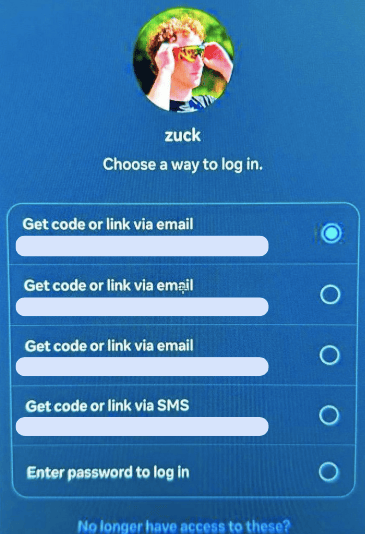
Notable victims of this Instagram recovery PII leak include members of the Kardashian family, Georgina Rodríguez, Kylian Mbappé, and even the boss man, Mark Zuckerberg himself.
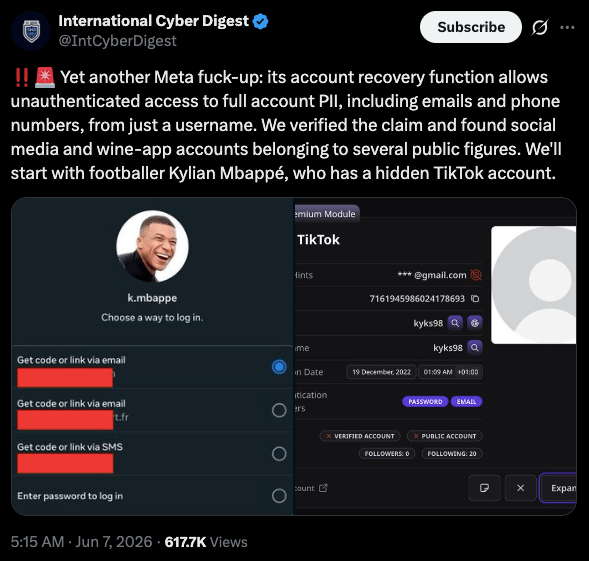
Moreover, OSINT enthusiasts quickly used the data to uncover secondary accounts, including previously hidden profiles linked to figures like Georgina Rodriguez and Mbappe. Even Mark Zuckerberg’s internal GitHub and Venmo accounts were discovered by internet nerds.
Do We Need to Re-Architect Social Media Login?
The case for decoupling contact information from social media has been floated since social media’s inception in the 2010s, pushed by privacy advocates. But there are severe practical cases that make it almost impossible, leaving it only partially in motion.
Email and phone no for Instagram serve three purposes:
- Verifying identity at signup
- Anchoring the recovery path
- Feeding the advertising infrastructure, which is where they make their money
Along with this, they are also connected to their other products, WhatsApp and Facebook. While rearchitecting is possible, it comes with a cost. Whether Meta will implement it by absorbing that cost is highly doubtful.
Privacy advocates have proposed pseudonymous identifiers, encrypted contact storage, and recovery flows that never surface PII at any confirmation step. Signal does a version of this, and enterprise identity management has done it for years.
An alternative model using a platform-assigned identifier with OTP-based recovery through a verified but never-displayed contact method is technically implementable, but the bigger picture is whether three billion users would accept it.
Asking an existing user base to migrate to a pseudonymous identity model immediately is a platform reinvention. The historical evidence does not support optimism. Every privacy-first social platform that has launched with minimal PII requirements has ended up serving the same demographic: people who care enough about privacy to tolerate the friction.
Even if they did, Instagram would shed users to the next platform that offers the same experience with the familiar login model, and that platform would rebuild the same architecture because bringing users without technical literacy onto anything more complex has never worked at scale.
The rearchitecting argument is correct, and it is not happening. What is possible is narrower: enforce email-to-account validation in the same code path that issues reset links, remove PII from every recovery confirmation UI, and mandate two-factor authentication for accounts above a defined threshold. These do not fix the underlying design but reduce the blast radius of the next bug without touching the incentive structure that makes the design rational for the platforms that run it.
Final Thoughts
Meta can absorb the fine, fight the legal battle, and wait for the news cycle to move on regarding this Instagram account recovery PII leak. They have done it before, and the math works in their favor every time. What they cannot easily absorb is the reputational cost of government accounts, verified institutions, and high-profile users getting repeatedly compromised on their platform due to this Instagram account recovery PII leak.
Those accounts are the credibility infrastructure that makes the platform worth advertising on. That is where a partial rearchitecting argument actually has legs, and there is a reasonable chance that Meta will roll out additional security features for these accounts in the next few months. Some of those users may even want it and ask for it.
While the economics do not favor a full re-architecting of Instagram’s login, what Meta should concentrate on is the code they ship and the engineering discipline to avoid this category of rookie mistake in the first place.
A trillion-dollar company that pioneered social media should not be filing breach notifications over a missing email validation check. The privacy advocates will keep making the structural argument, and they will keep being right. But the more immediate ask is to test your authentication flows like an attacker would, before an attacker does it for you.
FAQ
How did the Instagram password reset vulnerability work?
When someone triggers a password reset for any username, Instagram’s system returns the account’s full contact details, i.e., email address and phone number, without masking them. Attackers didn’t need to own the account or pass any verification step to see this information.
Could the Instagram account recovery PII leak have been prevented?
Yes, the Instagram account recovery PII leak came down to a missing validation check and could have been easily spotted during the security review. Enforcing that single check in the same code path that issues reset links would have stopped both the High Touch Support breach and the PII exposure before either reached a single user.